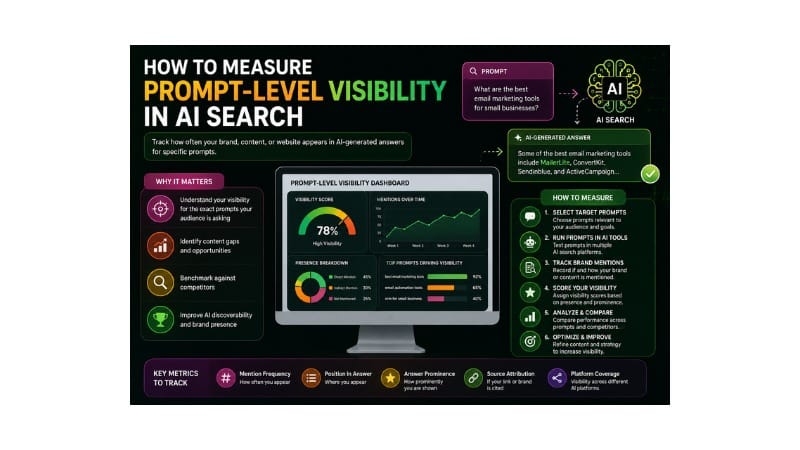
Have you noticed that strong keyword rankings no longer guarantee steady organic traffic? How to measure prompt-level visibility in AI search after seeing AI assistants answer user questions without showing long lists of web pages?
More so, many brands invest time and money in SEO but struggle to understand why AI platforms mention competitors instead. Search behavior has changed, and old ranking reports no longer tell the full story.
Modern AI search relies on prompts, context, trusted sources, and brand authority to generate answers. Business owners, marketers, and SEO professionals need a better way to track performance across AI search platforms.
Measuring prompt-level visibility helps you discover how often AI systems mention your brand, cite your content, and recommend your products or services. Clear data allows you to improve your strategy and stay visible as AI search continues to grow.
In addition, AI search has changed the way people find information online. Users now ask complete questions instead of typing short keywords. Large language models analyze each prompt, understand its meaning, and generate direct answers from trusted web sources.
Traditional SEO still plays an important role, but ranking on the first page no longer guarantees strong visibility in AI-generated responses. Modern businesses must track where their brands appear, how often AI systems mention them, and which prompts trigger those mentions.
Learning how to measure prompt-level visibility in AI search helps marketers understand brand exposure across platforms such as ChatGPT, Google AI Overviews, Perplexity, and Gemini. Reliable measurement also reveals content gaps, competitor strengths, and new opportunities to increase AI search visibility.
Decoding Prompt-Level Visibility: The New Standard for AI Search Visibility
Prompt-level visibility measures how often an AI search platform includes your brand, website, or content when responding to a user prompt.
Traditional SEO focuses on webpage rankings, while AI search focuses on answer generation. Modern AI systems may reference several trusted websites in one response instead of displaying ten blue links.
In addition, every prompt creates a unique search experience. Small wording changes often produce different citations and different brands. Measuring prompt-level visibility helps you understand where your content appears, which prompts generate mentions, and how your performance changes over time.
Strong prompt visibility also reflects topical authority. AI models prefer content that answers questions clearly, demonstrates expertise, and covers topics in depth.
Brands that monitor prompt performance regularly gain better insight into their AI search presence than businesses relying only on keyword rankings.
Core Architectural Mechanics: How Large Language Models Select and Cite Web Content
Large language models evaluate much more than keywords before generating an answer. They examine user intent, topic relevance, trusted sources, content quality, and relationships between ideas. Every prompt starts a process that identifies reliable information before building a natural response.
Thus, AI systems also compare information from multiple sources. Consistent facts, clear explanations, and well-organized content increase the chance of receiving a citation. Strong brand signals across trusted websites also improve recognition during response generation.

No Tech Jargon. Just More Customers.
We aren’t here to hide behind abstract technical metrics to mask a lack of results. Most agencies use complex algorithmic jargon just to confuse you and justify overcharging. JoseOne enjoys literally 100% client retention because, nothing is expensive when it’s worth what you pay for it.
How to Measure Prompt-Level Visibility in AI Search with Multi-Turn Prompts
Many users continue a conversation instead of asking one question. Follow-up prompts give AI models additional context and often produce different answers from the original query. Measuring visibility across single prompts alone creates an incomplete picture.
Build a prompt library that includes informational, commercial, navigational, and comparison questions. Test every prompt across multiple talks to discover how often AI systems mention your brand. Record citations, brand mentions, response quality, and competitor appearances during every testing session.
Long-term tracking reveals patterns that daily testing often misses. Regular measurements also show how new content influences AI citations across different prompt types.
Why Measuring Prompt-Level Visibility Matters for Brands and Marketers
Prompt-level visibility provides insights that traditional ranking reports cannot deliver. AI search platforms often answer questions without requiring users to visit a search results page. Brands that fail to appear inside those responses lose valuable exposure before users even reach a website.
Next, accurate measurement also supports better marketing decisions. Teams can identify high-performing prompts, discover missing content, and understand where competitors receive stronger AI visibility.
Performance data removes guesswork and helps businesses invest resources where they generate the greatest return. Brand mentions, AI citations, referral traffic, and prompt coverage together provide a clearer picture of digital performance than keyword rankings alone.
Companies that measure these signals consistently remain better prepared for future changes in AI-powered search.
Quantitative Analytics: Essential Metrics to Measure AI Search Visibility
Successful measurement starts with the right data. Keyword rankings alone no longer explain how AI search platforms present your brand. Modern SEO teams need performance metrics that reflect real AI visibility across different prompts and platforms.
Moreover, start by tracking prompt coverage. Prompt coverage shows how many target prompts mention your brand. Growing coverage often signals stronger topical authority and better content quality.
Next, measure citation frequency. Citation frequency shows how often AI platforms use your content as a trusted source. Frequent citations usually indicate that search systems trust your information.
Brand mentions also deserve close attention. AI assistants may recommend your company without linking directly to your website. Strong brand recognition helps build trust and increases future search opportunities.
Thus, another valuable metric measures the share of voice. Share of voice compares your visibility with competitors across the same group of prompts. Higher visibility often reflects stronger authority within your industry.
Referral traffic also provides useful insight. Analytics reports can reveal how many visitors arrive from AI-powered search experiences. Rising referral traffic often confirms that your content answers real user questions.
Finally, monitor conversion rates from AI referrals. More visitors create value only when they become subscribers, leads, or customers. Conversion data helps connect AI visibility with business growth.
How to Measure Prompt-Level Visibility in AI Search
Building a reliable measurement system requires a repeatable process. Consistent testing produces reliable data and helps marketers identify meaningful trends over time.
Furthermore, begin by collecting prompts that match real customer questions. Include informational, commercial, transactional, and comparison prompts. A balanced prompt list creates a broader view of AI visibility.
Run every prompt across multiple AI search platforms. Record every citation, brand mention, recommendation, and competitor appearance. Save every result inside a spreadsheet or tracking dashboard.
Repeat the same testing process every month. Regular monitoring helps identify changes after content updates or search algorithm changes. Historical data also reveals long-term performance patterns.
Compare your results with leading competitors. Strong competitor analysis highlights missing content, weak topic coverage, and new growth opportunities.
Group prompts into clear categories based on search intent. Organized reports help marketing teams understand where content performs well and where improvements remain necessary.
So, reliable measurement depends on consistency. Testing the same prompts under similar conditions creates cleaner data and more useful reports.
Choosing the Right AI Platforms and Tools for Prompt Tracking
Every AI search platform builds answers differently. Measuring visibility across only one platform creates an incomplete picture of overall performance.
Comparing ChatGPT, Google AI Overviews, Perplexity, and Gemini
ChatGPT often creates detailed conversational answers based on available knowledge and connected search sources. Brand mentions inside detailed responses reveal strong topical authority.
Google AI Overviews combine Google’s search index with AI-generated summaries. Strong visibility inside AI Overviews often depends on trusted content, technical SEO, and overall website authority.
Perplexity frequently displays source citations with its responses. Clear citations make performance tracking easier because marketers can quickly identify referenced pages.
Gemini combines Google’s AI technology with real-time search information. Response quality often changes according to search intent, prompt wording, and available sources.
Professional marketers should test identical prompts across every major platform. Side-by-side comparisons reveal important differences in citations, brand mentions, and response quality.
Several tools also support prompt tracking.
- Google Search Console monitors search performance and indexing.
- Google Analytics measures AI referral traffic and user behavior.
- Ahrefs Brand Radar tracks brand visibility across AI search.
- Goodie AI helps monitor prompt performance at scale.
- Enterprise AI monitoring platforms automate reporting for large websites.
Besides, combining manual testing with professional software creates more reliable insights than relying on a single tool. Regular reporting also helps teams react quickly when visibility changes.
Simple Affordable Rates
At JoseOne, we keep it simple. You don’t need a degree in search engine mechanics—you just need more traffic, more phone calls, and more sales. We offer one, fully-loaded package for just $3 per day, to get your business ranking higher on Google, with a 100% Money-Back Guarantee. We handle the technical heavy lifting so you can focus on running your business.
Building a Repeatable Prompt Tracking Database
Tracking prompt-level visibility once provides only a snapshot. A well-organized database reveals trends, supports better decisions, and helps teams measure progress over time.
Start by creating a spreadsheet or dashboard with separate columns for prompts, search intent, AI platform, date, brand mentions, citations, competitor mentions, and response quality. Organized records make future comparisons much easier.
Group prompts into categories such as informational, commercial, transactional, and navigational. Clear categories help identify which stage of the customer journey generates the strongest AI visibility.
Besides, record the exact prompt every time. Even small wording changes can produce different answers. Consistent testing creates reliable reports and reduces unnecessary variation.
Schedule monthly reviews instead of random checks. Regular reporting shows whether new content, technical updates, or algorithm changes improve prompt visibility.
So, historical data also helps marketing teams identify seasonal trends. Long-term records often reveal opportunities that short testing periods fail to uncover.
Common Challenges When Measuring Prompt-Level Visibility
Measuring AI visibility presents several challenges because AI systems generate dynamic answers instead of fixed search results.
Prompt wording creates the first challenge. A simple change in language may produce different citations, different sources, and different recommendations.
Search intent also influences every response. Informational prompts usually generate educational answers, while commercial prompts often recommend products, brands, or services.
In addition, AI models continue to evolve. Platform updates may change response quality without warning. Regular testing helps identify changes before they affect marketing performance.
Different AI platforms also evaluate content differently. One platform may mention your brand often, while another may recommend a competitor for the same prompt.
More so, large websites face another challenge. Hundreds or even thousands of prompts become difficult to manage without a structured tracking system. Reliable reporting requires patience, consistency, and organized data collection.
Reducing Personalization Bias and Model Differences
Personalization often changes AI responses based on user history, location, language, or previous conversations. Neutral testing conditions improve data quality and create fair comparisons.
Use the same prompt wording during every testing session. Consistent language reduces unnecessary variation between reports.
Test prompts from clean browser sessions whenever possible. Fresh sessions reduce the influence of previous searches.
Run identical prompts across multiple AI platforms instead of relying on one assistant. Broader testing provides a more balanced picture of prompt-level visibility.
Record testing dates because AI platforms update their models regularly. Historical records help explain sudden changes in citations or brand mentions.
Focus on long-term trends instead of single responses. Consistent patterns provide stronger insights than isolated results.
Ways to Improve Prompt-Level Visibility Without Keyword Stuffing
High prompt visibility comes from quality rather than repetition. AI systems reward useful information that answers real questions clearly. Write complete answers instead of short definitions. Detailed explanations help AI models understand your expertise.
Cover related topics within the same subject. Strong topical coverage increases the chance of appearing in different prompts. Support important claims with reliable facts, research, and original insights. Trustworthy information improves brand credibility.
Update important pages regularly. Fresh content often reflects current trends and changing user needs. Answer common customer questions in simple language. Clear explanations improve readability for both people and AI systems.
Build a strong brand across trusted websites. Consistent business information strengthens recognition and improves brand authority. Organize content with logical headings and descriptive titles. Clear structure helps AI systems understand important ideas faster.
Finally, focus on helping readers solve problems instead of forcing keywords into every paragraph. Valuable content earns more trust and stronger visibility.
Future Trends in Prompt-Level Visibility and AI Search Measurement
AI search continues to evolve at a rapid pace. Businesses need measurement systems that adapt to changing technology instead of relying on traditional ranking reports.
Future reporting platforms will likely measure prompt visibility, citation quality, brand authority, and share of voice inside one dashboard. Unified reporting will help marketers understand AI performance more accurately.
AI assistants will also improve their ability to understand user intent. Better understanding means content quality, expertise, and trust will become even more important.
However, brand authority will play a larger role as AI models continue learning from reliable sources. Companies that publish expert content consistently will gain stronger visibility across different AI platforms.
Marketing teams should also expect new analytics tools built specifically for AI search. Better software will simplify prompt tracking, competitor monitoring, and performance reporting.
Lastly, organizations that begin measuring AI visibility today will build stronger strategies for future search experiences. Continuous improvement, reliable data, and helpful content will remain the foundation of long-term success.
Frequently Asked Questions
What is prompt-level visibility in AI search?
Prompt-level visibility measures how often AI search platforms mention your brand, website, or content when answering user prompts. Strong visibility shows that AI systems recognize your content as a reliable source for relevant topics.
Which metrics help measure prompt-level visibility?
Important metrics include prompt coverage, citation frequency, brand mentions, share of voice, AI referral traffic, response consistency, and conversion rates. Together, these metrics provide a clear view of AI search performance.
Which AI platforms should marketers monitor?
Marketers should monitor ChatGPT, Google AI Overviews, Perplexity, and Gemini. Every platform generates answers differently, so comparing results across multiple AI systems provides a more accurate performance report.
How often should prompt-level visibility reports be updated?
Monthly reporting works well for most businesses. Regular reviews help identify content improvements, algorithm changes, and competitor movements before they affect long-term performance.
Why does prompt wording change AI search results?
AI systems analyze user intent behind every prompt. Small wording changes often produce different answers, citations, and recommendations. Testing several prompt variations creates a more complete measurement strategy.
Conclusion
To sum up, AI search continues to change the way people discover information online. Traditional keyword rankings still matter, but they no longer tell the complete story. Brands also need reliable data that shows how often AI systems mention, cite, and recommend their content.
Learning how to measure prompt-level visibility in AI search helps marketers understand brand exposure across modern AI platforms. Prompt tracking, citation analysis, competitor monitoring, and performance reporting provide valuable insights that support better marketing decisions.
Businesses that build a consistent measurement process gain a stronger view of AI search performance and uncover new growth opportunities.
Finally, clear reporting, high-quality content, and regular analysis will help your brand stay visible as AI search continues to evolve.