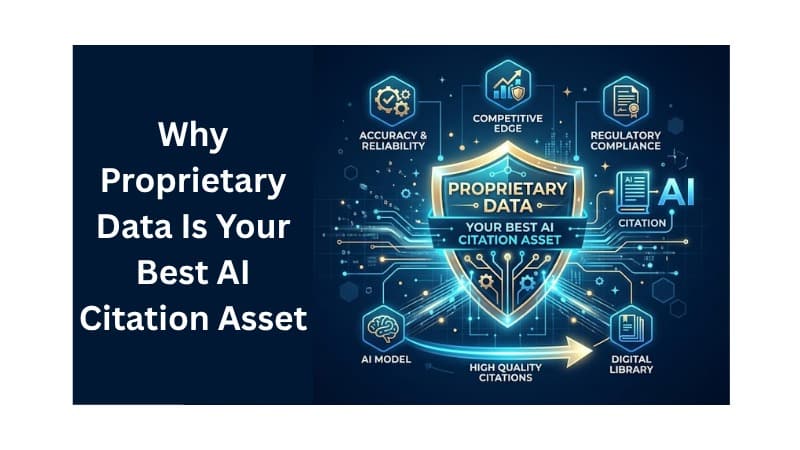
Do you remember when standard backlinks could put you at the top of Google overnight? New AI search engines changed those rules and made basic blogs invisible, but you can easily fix this traffic loss by learning why proprietary data is your best AI citation asset.
More so, the basic rules of tracking your search rankings have completely changed over the past year. Old search engines used to send people straight to a list of website links.
Today, smart AI engines give people direct answers instead of website addresses. Your online visibility now depends entirely on whether a machine chooses to quote your website in its source links.
You must offer unique value to win these premium source links. AI models need unique facts that they cannot scrape from standard public sites. So, this clear guide will show you how to build a strong data shield for your business.
You will discover why proprietary data is your best AI citation asset, how algorithms choose their sources, and how to stay a trusted leader in an AI-driven world.
Demystifying the AI Search Ecosystem: What Are AI Citations?
AI citations work like digital footnotes. AI tools pull facts from web pages and link back to them in responses. They differ from traditional SEO backlinks because AI chooses sources based on usefulness for a specific query.
Thus, perplexity often shows numbered sources with direct quotes. Gemini blends facts and adds links. ChatGPT cites pages that add fresh value. These citations expose your brand to users who trust the AI answer.
Real examples prove the power. A SaaS company shares proprietary benchmark data. AI tools cite it in reports about industry trends. Users click through and explore the full study.
What Is Proprietary Data and Why Does First-Party Insight Matter?
Proprietary data belongs to you alone. It comes from internal systems, customer surveys, or unique experiments. First-party insight matters because it offers details no one else holds.
More so, public data repeats everywhere. AI models see it as common knowledge. Your exclusive numbers provide fresh perspectives that stand out. Teams collect usage stats from their apps or run annual customer polls.
These assets create real value. You control the narrative and prove expertise with actual results. First-party data strategy turns raw observations into authority builders.
Proprietary vs. Public Data: Which Performs Better in the AI Era?
Proprietary data wins citation potential hands down. AI tools favor unique sources that reduce repetition. Public data offers broad context but lacks novelty.
In addition, user trust rises with original insights. People value brands that share exclusive findings. Long-term business ROI grows through repeated mentions and stronger authority.
Metric | Public Web Data | Proprietary Data |
Citation Potential | Very Low | Extremely High |
User Trust Level | Minimal | Maximum |
Long-Term Value | Low | High |
Risk of AI Copying | High | Low |

No Tech Jargon. Just More Customers.
We aren’t here to hide behind abstract technical metrics to mask a lack of results. Most agencies use complex algorithmic jargon just to confuse you and justify overcharging. JoseOne enjoys literally 100% client retention because, nothing is expensive when it’s worth what you pay for it.
The Core Mechanics: How AI Search Engines Choose Sources to Cite
AI search engines evaluate content quality signals first. They check the information gain score to see if the material adds new value. Source reputation and factual consistency play key roles too.
The Rise of GEO (Generative Engine Optimization) and Information Gain
Generative Engine Optimization helps content earn spots in AI answers. Information gain score measures how much fresh knowledge you provide. AI Overviews optimizes rewards pages that fill gaps in existing data.
LLM source selection favors depth and originality. Brands apply these principles and see more digital brand mentions.
The Anatomy of a Data Moat: Why Proprietary Data Is Your Best AI Citation Asset
AI models seek original research to avoid model degradation. Unique datasets lower duplication risks and deliver strong authority signals. LLMs crave content that expands their knowledge base.
Your data moat protects against generic summaries. Original research publishing creates barriers competitors cannot copy easily. Topical authority signals grow naturally from consistent exclusive insights.
High-Yield Assets: Types of Proprietary Data That Earn AI Citations
Industry surveys deliver strong results. Customer insights reveal real behaviors. Internal SaaS analytics show usage patterns no one else tracks. Benchmark reports and detailed case studies complete the mix.
Structuring Complex Data Sets for AI Discovery and Crawler Legibility
Structure matters for discovery. Clear tables, definitions, and headings help AI parse information. Structured data sets with proper labels boost crawler legibility and citation chances.
From Analytics to Footnotes: Turning Raw Data into Citation-Worthy Content
Convert internal numbers into research papers. Create interactive statistics pages that engage users. Data visualizations make complex ideas simple. White papers present findings with full context.
These formats transform raw data into shareable assets. Search engine optimization tracking shows which pieces earn the most citations over time.
Blueprint for Authority: Best Practices for Publishing Proprietary Research
Next, explain methodologies in clear steps. State sample sizes upfront for credibility. Maintain strict transparency in every claim. Design clear charts that highlight key takeaways.
Utilizing Advanced Schema Markup to Signal Algorithmic Trust
Advanced schema markup tells AI tools about your content. It highlights original research publishing and builds trust. Proper structured data sets reinforce your signals.
Optimization Pitfalls: Common Mistakes That Block AI Overviews and Citations
Thin content fails to impress. Unsupported claims raise doubts. Outdated statistics hurt credibility. Poor presentation hides valuable insights from crawlers.
Tracking Success: How to Measure AI Citations, Brand Mentions, and LLM Referral Traffic
Monitor mentions across AI platforms. Track brand mentions in responses. Analyze referral traffic from LLM sources. Search engine optimization tracking tools reveal patterns and opportunities.
Simple Affordable Rates
At JoseOne, we keep it simple. You don’t need a degree in search engine mechanics—you just need more traffic, more phone calls, and more sales. We offer one, fully-loaded package for just $3 per day, to get your business ranking higher on Google, with a 100% Money-Back Guarantee. We handle the technical heavy lifting so you can focus on running your business.
The Future of SEO: Becoming a Sustainable AI Citation Source
SaaS, FinTech, and healthcare industries must adapt fast. Build long-term topical authority through steady original research. Focus on first-party data strategy for lasting success.
Frequently Asked Questions
What makes data proprietary enough for AI citations?
Exclusive insights from your operations or customers qualify as proprietary. AI tools prefer information unavailable elsewhere on the web.
How does generative engine optimization differ from traditional SEO?
Generative Engine Optimization targets AI answers and citations. Traditional SEO focuses mainly on search rankings and blue links.
Which formats earn the most footnotes in AI responses?
Industry surveys, benchmark reports, and detailed case studies perform best. Clear structure and transparent methods increase success rates.
Can small teams build effective data moats?
Yes. Start with customer surveys and internal analytics. Publish findings consistently with proper formatting and schema markup.
How do you track citations in tools like Perplexity?
Use monitoring tools to scan AI responses. Analyze referral traffic and brand mentions regularly for patterns.
Conclusion
To sum up, AI search is completely changing how we write online content. You cannot protect your search traffic by just rewriting common public facts anymore. To survive this shift, you must create and publish your own unique business data.
When you share exclusive insights on why proprietary data is your best AI citation asset, you give search engines a clear reason to send users to your website.
Finally, this strategy turns your internal numbers into a powerful marketing shield. Always remember that proprietary data is your best AI citation asset if you want to win the future of search.