Years ago, engineers built a new airplane that looked shiny and fast on the ground. But the moment it flew into a real storm, the wings broke and it crashed to the earth.
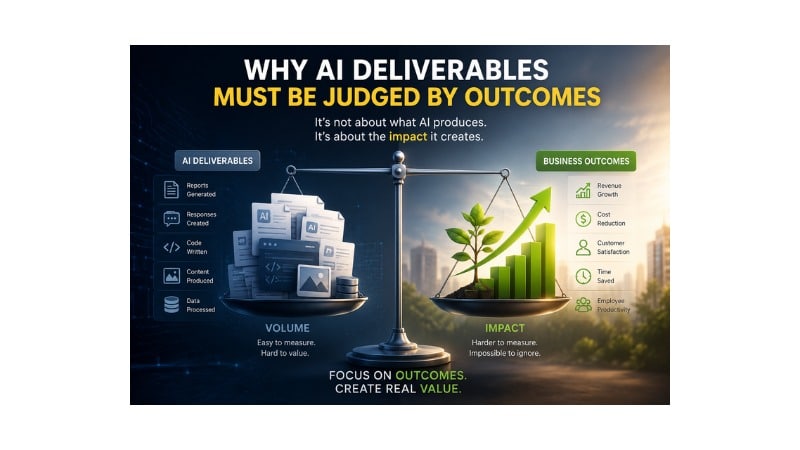
Today, we make the same mistake with technology when we praise a tool just because its work looks neat on our screens. We must stop looking at shiny drafts and finally learn why AI deliverables must be judged by outcomes.
The rapid rise of generative tools makes creating digital text, code, and analytics remarkably effortless. It takes only a few seconds to prompt a model and receive a polished, professional-looking deliverable.
However, this extreme generation speed creates a dangerous illusion for modern corporate leadership teams. A beautiful report containing subtle factual errors or code that breaks during integration creates massive operational liabilities.
To accurately calculate technology value, corporate leaders look past the immediate generation and track downstream performance. So, this strategic shift requires moving focus from what software builds to how it acts in production.
In this simple guide, we will break down why AI deliverables must be judged by outcomes, helping you avoid hollow metrics while protecting your long-term budgets, workflows, and bottom line.
Defining the Shift: Moving Beyond AI Outputs
Corporate leadership groups regularly experience a massive wave of excitement when launching new generative applications. A marketing bot writes ten complex articles in minutes while coding models spit out scripts instantly. These rapid technical results represent simple outputs, which describe the raw assets a system provides.
A recent Gartner study reveals that sixty percent of generative enterprise applications fail deployment trials.
So, this high failure rate happens because companies confuse rapid asset volume with genuine operational success. A document sounds highly intelligent while containing deep factual errors that completely ruin public brand trust.
[ Raw Machine Output ] —> [ Deep Human Review ] —> [ Actual Business Outcome ]
More so, shifting toward an outcome-driven AI strategy allows project managers to analyze actual, real-world business value. Teams stop counting the daily volume of items an automated system generates for their department. Instead, they track how those generated assets specifically improve operational efficiency over a longer timeline.

No Tech Jargon. Just More Customers.
We aren’t here to hide behind abstract technical metrics to mask a lack of results. Most agencies use complex algorithmic jargon just to confuse you and justify overcharging. JoseOne enjoys literally 100% client retention because, nothing is expensive when it’s worth what you pay for it.
Tracking Real Value: AI Business Impact Metrics
Upgrading your internal performance dashboards helps connect technical investments directly to your quarterly financial targets. Traditional engineering metrics like platform uptime do not explain if your enterprise is actually growing.
Businesses require distinct indicators that measure structural changes in human labor hours and customer retention.
According to research by McKinsey, automation tools can potentially lower corporate operational costs by thirty percent. Capturing these savings requires tracking workflow completion speeds rather than the volume of content produced. Leaders utilize these specific data points to justify expensive software budgets to their board directors.
Judging AI by Technical Outputs | Judging AI by Business Outcomes |
Number of content reports generated | Total revenue generated from campaigns |
Model processing speed in seconds | Overall customer satisfaction score |
Total lines of raw code produced | Hours of human labor saved weekly |
Total computational tokens consumed | Reduction in weekly system error rates |
Thus, board executives do not want to hear about complex neural networks or model training data. They demand clear, undeniable evidence of protected capital, saved time, and accelerated company market growth.
Focusing heavily on behavioral outcomes ensures your corporate technology investments deliver authentic and measurable financial gains.
High Accuracy Can Still Miss the Mark: Why AI Deliverables Must Be Judged by Outcomes
A technical data science group celebrates when an application hits ninety-nine percent laboratory accuracy scores. Its impressive score looks perfect on paper but frequently causes total failure during live deployment. Systems operate flawlessly while predicting consumer trends that an enterprise cannot actively exploit in reality.
True operational success requires a tool to blend perfectly into the daily habits of employees. Workers quickly abandon new digital platforms that feature confusing interfaces or require slow, repetitive steps. An accurate system that your workforce rejects delivers zero financial return on investment for your firm.
So, this common corporate disconnect highlights why AI deliverables must be judged by outcomes across every modern sector. Project managers ensure their technical evaluation metrics align completely with existing human employee workflows.
Next, embracing this balanced perspective allows high model accurcy to translate directly into larger enterprise profits.
Dangers That Hide in Output-Focused Approaches
Surface-level technical victories create massive, hidden operational risks for unsuspecting corporate leaders across global markets. The dangerous demo trap pulls capital into flashy ideas that fall apart during live operations. Employees feel highly productive while generating massive piles of digital assets that lack long-term utility.
A modern socio-technical AI assessment combines strict software logic audits with deep human workplace factors. Evaluating both sides of technology deployment helps managers spot systemic operational risks before they expand.
How Business Results Outweigh Shiny Deliverables
An outcome-first mindset connects digital software deployments directly to major high-level corporate boardroom discussions. Finance executives approve software budgets only for technology projects that demonstrate clear paths to profit. They prioritize tools that lower customer churn or shorten sales cycles over generic software features.
Implementing strict AI accountability standards provides your company with a highly structured software deployment roadmap. Clear asset ownership rules guide every stage of development, protecting data integrity and reducing systemic liability. Your employees always know which specific manager answers for the final performance of automated tools.
- Role Definition: Assign a clear human owner to every active automation tool.
- Escalation Protocols: Create documented steps for handling automated data errors quickly.
- Sign-off Requirements: Mandate manager approval before publishing any computer-generated material.
Adopting this disciplined approach allows your enterprise to build a highly sustainable long-term competitive edge. Companies that track behavioral outcomes accurately scale successful tools while quickly eliminating apps that drain capital.
So, this strategic focus ensures your digital investments elevate corporate performance instead of complicating current operations.
Simple Affordable Rates
At JoseOne, we keep it simple. You don’t need a degree in search engine mechanics—you just need more traffic, more phone calls, and more sales. We offer one, fully-loaded package for just $3 per day, to get your business ranking higher on Google, with a 100% Money-Back Guarantee. We handle the technical heavy lifting so you can focus on running your business.
Unlocking Strong Returns Through Smart Measurement
Utilizing outcome-based AI evaluation helps corporate groups unlock massive returns on their digital software investments. Department managers secure rapid executive funding by proving their tools solve explicit operational pain points. Capital flows away from trendy tech experiments and directly into systems with highly predictable financial returns.
A recent Deloitte survey indicates that outcome-focused companies achieve forty percent higher tech returns. Measuring AI return on investment requires balancing initial setup fees against long-term human resource savings. Your business loses money when software maintenance fees outweigh the value of freed employee hours.
Total Setup Cost (Licenses + Cloud + Labor) vs. Long-Term Operational Gains
Regular financial reviews prevent teams from wasting valuable time on broken or inefficient software applications. Leaders use concrete performance numbers to determine which digital platforms merit further corporate expansion funding. Keeping your balance sheet clear of empty technology trends keeps your entire enterprise financially healthy.
Real-World Case Studies: Outcome-Based AI Success Across Industries
Global fintech giant Klarna recently deployed an automated customer support application to manage user questions. The system successfully handled two-thirds of all chat queries during its initial months of operation.
Thus, this deployment cut customer resolution times from eleven minutes to under two minutes for global shoppers.
The true business outcome showed a forty million dollar boost in profits for the company. They did not just measure how fast the model replied to simple user chat prompts. They focused on actual cost reductions and massive improvements in overall customer experience ratings worldwide.
[ Klarna Case Study ] —> [ Old Speed: 11 Mins ] —> [ Outcome Speed: 2 Mins ] —> [ $40M Profit Boost ]
In the financial sector, JPMorgan Chase uses advanced predictive software to inspect complex legal documents. The application extracts vital data points from thousands of commercial loan agreements in a few seconds. Its tool saves the bank three hundred thousand hours of manual human legal review annually.
Key Metrics That Matter for Lasting Value
Smart managers skip counting generated text lines or tracking raw API token metrics entirely today. They leverage precise AI business impact metrics to observe how applications alter core commercial operations.
Excellent indicators track customer subscription renewals, employee task completion speeds, and down-funnel digital conversion rates.
Technical metrics still play an important role by supporting your primary high-level corporate goals. Software speed and algorithm uptime provide a strong base for achieving better customer service outcomes. Data teams must combine technical indicators with business goals to build a complete performance map.
[ Technical KPI: Model Speed ] —> [ Business KPI: Faster Customer Resolution ]
Deploying reliable AI auditing frameworks ensures your automated applications remain safe, fair, and legally compliant. Regular performance checks catch model drift before digital errors skew your quarterly operational data sets.
Constant oversight keeps your technology assets aligned with shifting consumer behaviors and market trends over time.
A Practical Framework for Your Team
Begin your digital automation project by defining narrow, specific, and highly practical business performance objectives. Record precise baseline numbers from your current human workflows before purchasing any new software tools.
So, this essential step allows your team to prove actual efficiency gains after launching the application.
- Objective Alignment: Map every automated tool directly to an existing corporate financial goal.
- Workflow Testing: Test software usability with actual employees before deploying systems to customers.
- Continuous Adjustment: Schedule monthly prompt optimization reviews to maintain high generation quality.
Next, execute thorough AI production readiness checks to evaluate how software integrates with your platform. Test the application using messy real-world data to ensure it handles high traffic volumes safely. Gathering honest feedback from actual users helps your developers refine system prompts and interfaces quickly.
Governance, Human Oversight, and Accountability
Technology governance has become an absolute necessity for modern corporations operating in highly regulated spaces. Human review gates remain essential for managing automated workflows and verifying high-stakes financial data sets. System transparency builds deep client trust while protecting your enterprise from damaging public relations crises.
A comprehensive socio-technical AI assessment studies how new software platforms alter daily workplace culture. Evaluating both system code and employee stress levels helps managers maintain a healthy corporate environment. Guarding against digital skill loss ensures your workforce remains highly capable if systems go offline.
+———————————–+
| Socio-Technical AI Assessment |
+———————————–+
|
+———————-+———————-+
| |
v v
[ Human Cultural Impact ] [ Technical Infrastructure ] – Team dynamics changes – System speed and uptime – Staff stress levels – Data security protocols
– Daily habit shifts – Cloud integration ease
Setting clear AI accountability standards helps leaders manage operational risk when digital systems make errors. Your company policies must explicitly state which human executive bears responsibility for automated decisions.
Furthermore, this legal and ethical clarity keeps your business operating safely, responsibly, and professionally always.
Action Steps for Leaders
Corporate executives must ask highly specific questions before investing capital in new automation software platforms.
What precise operational problem does this tool solve for our current customer base right now? Do we possess reliable human baseline data to measure performance improvements after we launch this?
[ Ask: What is the core problem? ] —> [ Check: What is the baseline? ]
More so, signs of genuine technology value appear in upgraded employee habits and positive quarterly budget numbers. Scale your successful software projects while quickly pausing applications that drain cash or stall operations.
So, this strategic playbook turns vague software expenses into highly predictable, profit-generating corporate assets for your firm.
Frequently Asked Questions
What separates AI outputs from true outcomes?
Outputs include generated text, raw code, or simple automated predictions. Outcomes show actual changes in company revenue, employee efficiency, or final customer happiness.
Can a model stay accurate yet still disappoint?
Yes. High accuracy on test data differs from real usefulness. System integration issues or user trust gaps cause many accurate tools to fail.
Which metrics best show AI success?
Business impact metrics like hours saved, error reductions, and revenue lifts work best. They link technology directly to your financial goals.
How should leaders review AI spending?
Leaders must check original baselines, clear business goals, and concrete proof of change. They should look closely at workflow fit and actual tool adoption.
What common errors hurt AI measurement?
Teams often chase vanity numbers like generation speed. They skip recording baselines and ignore human workplace factors. Operational results always suffer.
Conclusion
Lastly, the true value of artificial intelligence does not lie in its ability to generate massive amounts of data at lightning speed. It lies in its power to solve real business problems and streamline human workflows.
Organizations that measure AI by business outcomes—not just technical outputs—are more likely to achieve sustainable ROI, stronger user adoption, and long-term competitive advantage. Moving away from superficial metrics and strictly focusing on why AI deliverables must be judged by outcomes ensures your investments build lasting corporate value.