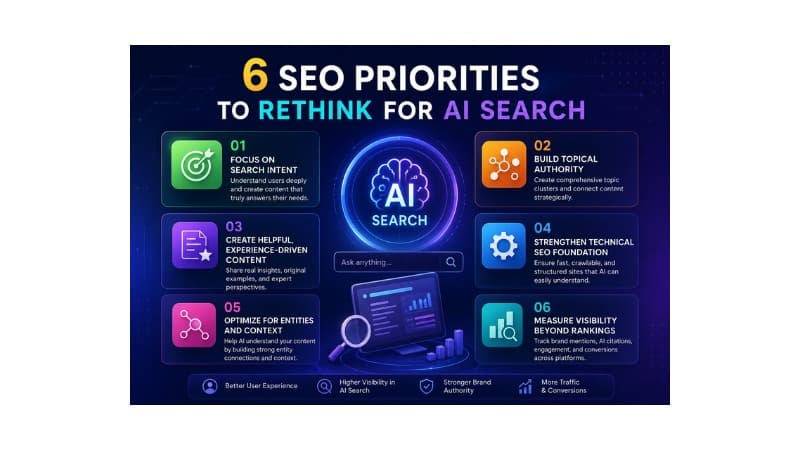
Do you still spend long hours tracking individual keyword rankings on standard search dashboards? You might look at your dropping traffic charts and ask yourself, “What is the best strategy for the 6 SEO priorities to rethink for AI search?”
In addition, many business owners realize that old-school marketing playbooks fail to capture clicks inside conversational answer screens. You can protect your online visibility once you learn how generative systems process content. Let us explore the primary shifts you need to make to stay relevant in a changing digital market.
Generative search assistants now rewrite the way everyday people look for information online. Instead of browsing through lists of blue links, users read direct summaries generated by large language models.
Furthermore, a massive behavioral shift means your website layout must change its delivery format to survive. When you restructure your text, you allow smart algorithms to extract your business insights with ease.
A modern approach focuses on providing clear context rather than repeating exact phrase matches across your landing pages. You must treat your website as an interconnected repository of industry facts that machines can easily reference.
So, adapting to these new requirements ensures your brand remains visible when customers seek recommendations through chat tools. Let us examine the exact steps needed to upgrade your organic visibility strategy for future growth.
How AI Search Works: 6 SEO Priorities to Rethink for AI Search
Modern AI search platforms deliver answers differently from traditional search engines. Instead of showing a simple list of web pages, they analyze a user’s prompt, understand its intent, and generate a direct response by combining information from multiple trusted sources.
The shift means websites must provide clear, accurate, and well-structured content that AI systems can easily interpret.
Unlike traditional search, AI search evaluates context, entities, topical authority, and content relationships rather than relying heavily on exact-match keywords.
Strong internal linking, logical site organization, and comprehensive content help AI models understand how different pages connect. Websites that clearly demonstrate expertise and thorough answers to user questions are more likely to be referenced in AI-generated responses.

No Tech Jargon. Just More Customers.
We aren’t here to hide behind abstract technical metrics to mask a lack of results. Most agencies use complex algorithmic jargon just to confuse you and justify overcharging. JoseOne enjoys literally 100% client retention because, nothing is expensive when it’s worth what you pay for it.
The Algorithmic Shift: Why Generative AI Is Changing Traditional Search Engine Mechanics
Traditional search tools functioned like digital libraries that matched exact words to specific page documents. Modern answer platforms operate like smart consultants that synthesize deep concepts from multiple websites simultaneously.
More so, the technical evolution alters how data flows from your server to the end user’s screen. Publishing habits must adapt quickly to match this advanced machine learning landscape.
Chat tools analyze user prompts as continuous conversations rather than isolated search events. They evaluate the comprehensive meaning behind a user’s question before presenting a customized response block. Your pages will lose visibility if they only address shallow definitions without offering deeper technical context. Brands must design content that satisfies complex multi-turn inquiries to retain their digital market share.
Priority 1: Shifting Focus from Exact-Match Keywords to Real User Search Intent: 6 SEO Priorities to Rethink for AI Search
Consequently, forcing exact target phrases into every header tag makes your text sound robotic to readers. Generative engines possess advanced language processing capabilities that recognize synonyms and contextual clues.
You should focus your energy on answering specific customer pain points completely. Writing naturally helps your text align with how real people speak their queries into mobile devices.
You can determine intent by studying the follow-up questions users ask during their research journeys. Group these related questions together into logical topic segments before you begin drafting new articles.
Moreover, the careful organization allows you to address the entire customer journey within a single comprehensive resource page. Satisfying multiple intents simultaneously encourages search algorithms to choose your site as a trusted source.
Priority 2: Building Broad Topical Authority Instead of Publishing Isolated Pages
Furthermore, publishing random blog posts about disconnected subjects puzzles both human visitors and automated search crawlers. You must create a centralized pillar page that serves as the main command center for each core business topic.
The internal links distribute ranking power evenly across your entire content ecosystem instead of bottlenecking on the homepage. Organizing your pages into semantic clusters ensures no valuable information gets lost in deep site directories.
- Pillar Hub Page: Provides a broad overview of a major topic area while linking out to all subtopics.
- Supporting Article: Explains a specific, narrow question in detail while linking back to the parent hub.
Priority 3: Creating Helpful Content That Demonstrates Real Experience
Meanwhile, AI models train on vast public data sets, meaning they already know standard textbook definitions. Rephrasing common knowledge over and over provides zero informational gain to the web landscape.
Sharing original data from your own client campaigns forces search engines to take notice of your brand. Unique case studies make your content highly valuable to scrapers looking for fresh source material.
- Proprietary Metrics: Internal company performance tracking offers high value because competitors cannot duplicate the data.
- Field Experiments: Real-world tests and recorded outcomes provide excellent signals for building deep contextual trust.
Priority 4: Optimizing Your Digital Platform for Entities and Broad Context
Search systems now categorize the web by mapping real-world entities like people, places, and business brands. Your company needs a clear digital footprint so algorithms can accurately link your name to specific product categories.
You can build this context by maintaining identical business information across all major public profiles. Consistency across the web helps machines verify your actual industry position.
You should use precise language when describing your services to avoid confusing automated classification filters. Avoid using vague jargon that conceals the true nature of your commercial offers.
In addition, connecting your brand name directly to established industry concepts makes it easier for AI models to recommend your business. The clear positioning builds long-term contextual trust across the entire search ecosystem.
Priority 5: Upgrading Technical SEO Elements to Support Machine Understanding
Therefore, a structured data schema acts as a direct translator between your website code and machine learning systems. The backend markup explicitly defines variables like product prices, author credentials, and event dates without room for error.
You must implement clean schema files to help automated bots parse your layout rapidly. The table below lists the essential technical elements you need to maintain.
Technical Asset | Core Technical Purpose | Expected Site Benefit |
Organization Schema | Defines your brand entities and social proof profiles. | Clearer brand recognition by AI bots. |
Core Web Vitals | Measures page responsiveness and visual stability. | Lower bounce rates from mobile users. |
Maintaining quick server response times prevents search bots from abandoning your page mid-crawl to save power. Slow loading times cause automated bots to skip your deep directories entirely.
Clean code structure remains an absolute necessity for keeping your platform visible to modern indexing pipelines.
Simple Affordable Rates
At JoseOne, we keep it simple. You don’t need a degree in search engine mechanics—you just need more traffic, more phone calls, and more sales. We offer one, fully-loaded package for just $3 per day, to get your business ranking higher on Google, with a 100% Money-Back Guarantee. We handle the technical heavy lifting so you can focus on running your business.
Priority 6: Measuring Visibility Metrics Beyond Traditional Blue Link Rankings
Accordingly, old analytics systems focused entirely on measuring your exact position on a static page of ten search results. Modern success tracking requires you to monitor how often AI models include your brand name in their answers.
Thus, you must measure your share of voice across multiple conversational assistants rather than tracking single keywords. Shifting your measurement mindset helps you judge the true health of your digital presence.
[Old Tracking] ──> Monitor Static Keyword Positions ──> Limits Strategy
[Modern Tracking] ──> Measure AI Citations + Brand Mentions ──> Captures True Reach
You can track success by watching your direct organic referral traffic from generative platforms. Look at your internal analytics to see which specific content blocks trigger the highest number of conversational click-throughs. Gathering this interaction data allows you to optimize your text layouts for the prompts that drive real conversions.
Tools That Help Optimize for AI Search
Measuring and improving AI search performance requires more than traditional rank-tracking software. Website owners should combine SEO platforms with analytics and technical auditing tools to understand how their content performs across different search experiences.
Google Search Console helps monitor indexing, crawl issues, and search performance, while Google Analytics reveals user engagement and conversion data.
Technical auditing tools such as Screaming Frog SEO Spider, Ahrefs, and Semrush identify internal linking issues, broken pages, structured data errors, and other technical problems that may reduce AI visibility.
Regularly reviewing these insights helps businesses refine their content strategy and improve their chances of appearing in AI-generated answers.
Side-by-Side Comparison: Traditional Keyword SEO vs. Modern AI Search SEO
Alternatively, building a sustainable marketing plan requires a clear understanding of how optimization goals change over time. Many teams waste valuable time applying outdated tactics to platforms that no longer value them.
The table below outlines the core strategic differences you must understand to manage your assets effectively.
Optimization Vector | Old-School Keyword Framework | Modern Conversational Layout |
Primary Goal | Win top positions for single keywords. | Secure conversational citations and brand mentions. |
Content Strategy | Write separate short pages for keyword variants. | Build deep topic clusters around core pillar pages. |
Success Metrics | Monitor rank tracking tools daily. | Measure referral traffic and brand visibility share. |
Common Optimization Mistakes That Hurt Your Generative Search Visibility: 6 SEO Priorities to Rethink for AI Search
Writers often stuff pages with repetitive keyword strings that destroy the natural flow of your sentences. E-commerce sites frequently copy manufacturer product descriptions instead of writing unique value propositions for buyers.
Technical teams sometimes allow broken internal redirect loops to deplete your daily server crawl limits unnecessarily. Many website owners isolate their blog posts by forgetting to build clear navigation paths between related topics.
Furthermore, isolated text blocks remain invisible to search spiders because no internal links guide the bot to the destination. Simplifying your site taxonomy allows algorithms to index your new content within fewer crawl cycles. You must eliminate orphan pages to ensure search engines categorize your entire domain correctly.
Best Practices to Prepare Your Entire Website Framework for Future Trends
Maintaining factual accuracy across your entire article catalog represents the easiest way to preserve search visibility. Generative systems cross-reference data points across multiple domains to filter out inaccurate or outdated statements.
You must update your older guidebooks with fresh statistics to prevent filters from marking your site as low quality. Clean editing preserves your hard-earned authority scores over time.
Besides, you should design your content layouts to deliver direct answers within the opening sections of your pages. Placing summary boxes at the top of your text helps automated scrapers identify key takeaways instantly.
The scannable presentation style satisfies both impatient human readers and fast-moving search bots. Aligning your digital design with these modern habits ensures your business succeeds under the framework of 6 SEO Priorities to Rethink for AI Search.
Frequently Asked Questions
Do traditional search engine optimization tactics still matter in an AI search environment?
Basic technical health remains crucial because conversational platforms still rely on standard web indexes to gather their facts. You must maintain clean code structures and fast server speeds so scrapers can read your text easily.
How can small businesses compete for visibility inside conversational answer engines?
Small brands can win premium citations by publishing hyper-specific local insights and exclusive industry case studies. Focus on dominating a narrow niche topic rather than trying to cover general subjects.
Should I completely stop tracking single keyword positions on my analytics dashboard?
Keyword tracking still provides basic data regarding general market interest trends over time. However, you should prioritize measuring comprehensive brand mentions and actual organic conversion traffic over single rank positions.
What is an entity map, and how does it change content creation styles?
An entity map connects real-world concepts, brands, and people together based on their logical relationships. Writers must structure their text to explicitly state these connections so search engines understand the exact context.
Why do generative assistants sometimes ignore highly ranked traditional websites?
AI models prioritize original insights and unique data over websites that simply aggregate existing web articles. So, if your content lacks unique value, answer engines will source their summaries from other domains.
Conclusion
To sum up, succeeding in the modern search market requires digital brands to prioritize real user answers over rigid keyword rules. You must treat your website as an open data network that delivers immediate, clear value to every visitor.
Upgrading your internal links and cleaning your technical markup removes the barriers that block automated system crawlers. When you adapt your strategy to match the 6 SEO priorities to rethink for AI search, you build a powerful platform that grows alongside changing technology trends.