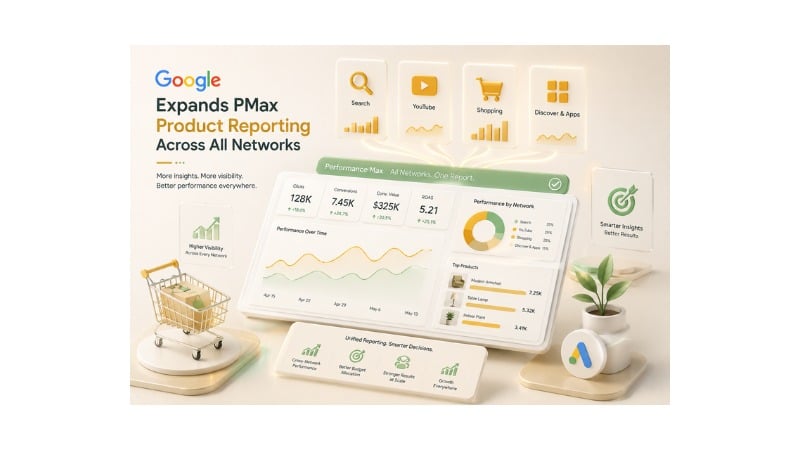
How did web ad metrics change overnight when Google expands PMax product reporting across all networks? Advertisers once relied on limited product data to measure campaign success.
Today, Google combines product performance from multiple networks into one complete reporting view.
Google continues improving Performance Max reporting for advertisers and online businesses. Earlier reports showed product performance from only a few Google channels.
As a result, Google expands PMax product reporting across all networks to provide a more complete view of campaign performance. The update brings product-level data from multiple Google networks into one reporting dashboard.
Advertisers can compare results more easily and understand how each product performs across different placements. Marketing teams can now make smarter decisions using more accurate campaign insights.
What Is Google’s Expanded Performance Max Product Reporting Update?
Next, Google expanded Performance Max product reporting to help advertisers understand product performance across every supported network. The updated reports combine data from multiple Google properties into one clear view.
Store owners can evaluate product performance without switching between separate reports. Marketing teams can identify successful products and improve campaign strategies with greater confidence.
More so, developers can also improve reporting tools and automation by using more detailed campaign data. Better reporting helps advertisers make informed decisions based on reliable performance metrics.
What the Expanded Reports Include: Google Expands PMax Product Reporting Across All Networks
The updated reporting provides valuable product insights across Google’s advertising networks, including:
- Product impressions across supported networks.
- Clicks and conversion data for individual products.
- Revenue and return on ad spend (ROAS).
- Product performance across multiple campaign placements.
These insights help advertisers understand overall product performance from one reporting interface.
How Product Reporting Works Across Search, YouTube, Display, and Maps
Google collects product performance data from several advertising networks and combines it into one report. Advertisers no longer need to compare separate reports to understand campaign performance.
The updated dashboard includes product data from Search, Shopping, YouTube, Display, Discover, Gmail, and Maps where supported. Each network contributes performance metrics that improve campaign visibility.
Afterward, marketing teams can identify where products perform best across Google’s advertising ecosystem. Better reporting supports smarter budget planning and stronger campaign optimization.

No Tech Jargon. Just More Customers.
We aren’t here to hide behind abstract technical metrics to mask a lack of results. Most agencies use complex algorithmic jargon just to confuse you and justify overcharging. JoseOne enjoys literally 100% client retention because, nothing is expensive when it’s worth what you pay for it.
Why Did My Google Ads Metrics Increase After the Update?
Many advertisers noticed higher impressions, clicks, and other campaign metrics after the rollout. The increase reflects broader reporting instead of sudden growth in campaign performance.
Google now includes product activity from additional networks that earlier reports did not display. Understanding this reporting change helps advertisers compare campaign performance more accurately.
Later, reviewing updated baselines prevents confusion and supports better long-term performance analysis. Careful evaluation leads to smarter advertising decisions.
What New Product Performance Data Can Advertisers See?
Following that, advertisers can review more detailed product insights than before. Expanded reports display product impressions, clicks, conversions, revenue, and return on ad spend across supported networks.
Retail businesses can compare products to identify high-performing items and improve marketing strategies. Better reporting also highlights products that need stronger optimization.
Advertisers can use the new insights to:
- Find products that generate the highest sales.
- Identify products with lower conversion rates.
- Improve product feeds and campaign assets.
- Allocate budgets based on verified performance data.
- Monitor results across multiple Google networks.
The expanded reports make campaign optimization easier by providing a complete picture of product performance.
Why This Update Matters for Performance Max Campaigns
Then, accurate reporting helps advertisers understand how products perform across every supported Google network. The expanded reports remove reporting gaps and provide a complete view of campaign performance.
Store owners can make better budget decisions with reliable product-level insights. Marketing teams can also identify successful products and adjust campaigns with greater confidence.
Better visibility reduces guesswork and supports stronger bidding strategies. Advertisers can improve campaign performance by focusing on products that deliver the best results.
How Advertisers Can Use the Expanded Reporting Features
Advertisers can use the new reports to improve Performance Max campaigns through better product analysis. The expanded data helps teams understand which products perform well across different networks.
Marketing teams should focus on these best practices:
- Review product performance across every supported network.
- Identify products with the highest conversions and revenue.
- Improve product titles, images, and descriptions.
- Adjust budgets based on verified performance data.
- Test creative assets for stronger engagement.
- Monitor reports regularly to track campaign changes.
Besides, using these insights helps advertisers improve campaign performance without increasing unnecessary ad spending.
Benefits of Full-Network Reporting for E-commerce Businesses
E-commerce businesses gain a complete view of customer activity across Google’s advertising platforms. The updated reports help merchants understand how products perform throughout the buying journey.
Meanwhile, retailers can identify products that attract more clicks, conversions, and sales. Better reporting also helps businesses improve inventory planning and promotional strategies.
Full-network reporting offers several important benefits:
- Better product performance insights.
- Smarter budget allocation.
- Stronger return on ad spend (ROAS).
- Faster campaign optimization.
- Better decisions based on complete reporting.
Businesses that review these reports regularly can improve both advertising performance and overall sales.
Why This Update Matters for Digital Marketers
Digital marketers can use expanded product reporting to improve paid advertising and overall marketing strategies. Better campaign insights help teams understand which products attract the most customer interest.
Marketing teams can combine Performance Max data with SEO and content strategies to create a stronger online presence. Shared insights also improve collaboration between advertising and content teams.
Likewise, the expanded reporting supports better planning, stronger campaign management, and improved business growth. Reliable data allows marketers to make confident decisions across every stage of the customer journey.
Best Practices for Using Google’s Expanded PMax Reporting
Finally, advertisers should use the expanded reports to make smarter campaign decisions across every supported Google network. Regular analysis helps identify successful products and areas that need improvement.
Follow these best practices to get better results:
- Segment product performance by network.
- Compare current results with updated reporting baselines.
- Improve product titles, descriptions, and images.
- Monitor return on ad spend (ROAS) for every product.
- Adjust budgets based on verified performance data.
- Review reports regularly to identify new optimization opportunities.
Consistent analysis helps advertisers improve Performance Max campaigns while making better business decisions.
Simple Affordable Rates
At JoseOne, we keep it simple. You don’t need a degree in search engine mechanics—you just need more traffic, more phone calls, and more sales. We offer one, fully-loaded package for just $3 per day, to get your business ranking higher on Google, with a 100% Money-Back Guarantee. We handle the technical heavy lifting so you can focus on running your business.
Reporting Limits and Common Mistakes to Avoid: Google Expands PMax Product Reporting Across All Networks
Advertisers should understand that expanded reporting may change how campaign data appears. Comparing older reports with updated reports without adjusting baselines can create misleading conclusions.
Therefore, performance data may also take time to update after campaigns receive new traffic. Marketing teams should allow enough time before evaluating campaign performance.
Common mistakes include:
- Comparing old and new reports without considering the reporting update.
- Making budget changes too quickly.
- Ignoring product-level performance trends.
- Focusing only on clicks instead of conversions and revenue.
- Skipping regular report reviews.
Careful analysis leads to stronger optimization and better long-term campaign performance.
What Google’s Expanded Reporting Means for the Future of Performance Max
Google continues improving Performance Max with better reporting and smarter automation. Expanded product reporting gives advertisers more useful insights into campaign performance across Google’s advertising networks.
Future updates may include deeper AI-powered reporting, stronger product recommendations, and more detailed campaign analysis. Better reporting will help businesses make faster decisions and improve advertising performance.
Moreover, advertisers who understand the new reporting features will gain greater value from their campaigns. Regular optimization and accurate reporting remain essential for long-term success.
Frequently Asked Questions
What is Google’s expanded PMax product reporting?
Google’s expanded PMax product reporting gives advertisers detailed product performance data across supported Google advertising networks.
Which Google networks are included in the new reports?
The reports include data from Search, Shopping, YouTube, Display, Discover, Gmail, and Maps where supported.
Why did Google expand product reporting?
Google introduced the update to give advertisers a more complete view of product performance across multiple campaign placements.
How can advertisers use the new reporting?
Advertisers can identify top-performing products, improve budgets, optimize product feeds, and strengthen Performance Max campaigns.
Will the new reporting improve campaign performance?
The reports provide better insights for campaign optimization. Advertisers who use the data effectively can make stronger marketing decisions.
Summing Up
Finally, expanded reporting gives advertisers a clearer understanding of how products perform across Google’s advertising ecosystem. Better visibility helps businesses improve budgets, optimize campaigns, and identify products that drive the strongest results.
Marketing teams should review reports regularly, improve product feeds, and make decisions based on verified performance data. These practices help advertisers achieve stronger results as Google continues improving Performance Max.
Businesses that adapt early will gain greater value from future reporting improvements. Staying informed remains the best way to succeed as Google expands PMax product reporting across all networks and delivers more detailed insights for advertisers.