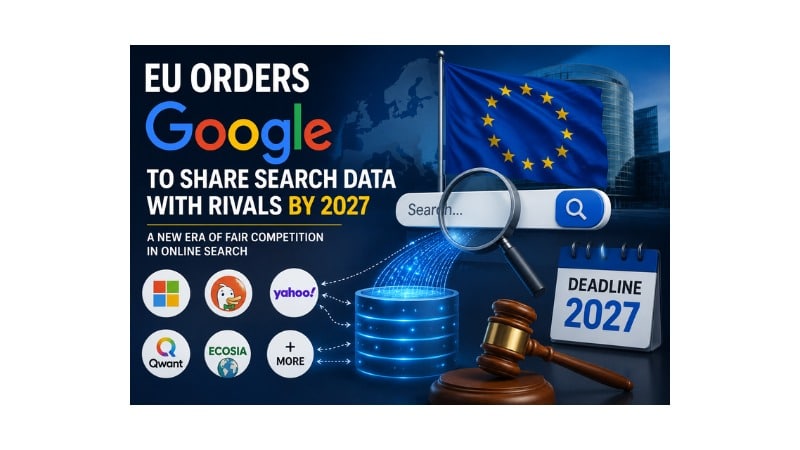
Did you know one technology company once kept most search data to itself? How will online search change now that the EU orders Google to share search data with rivals by 2027?
Meanwhile, the European Union wants to create a fair online search market for every technology company. Regulators introduced new rules under the Digital Markets Act.
As a result, the EU order for Google to share search data with rivals by 2027 became one of the biggest digital market decisions in Europe.
The new rules require Google to share anonymized search queries and click data with qualified search engines and AI platforms. Rival companies can use that information to build better search tools and improve user experiences.
More so, this guide explains what the decision means for Google, competitors, website owners, and everyday users.
Let’s get started!
What Is the EU’s New Data-Sharing Mandate for Google?
European Union regulators instructed Google to share part of its search data with qualified competitors. The decision aims to create fair competition across European digital markets while encouraging innovation.
Next, smaller companies often struggle because they cannot access large amounts of search data. European officials believe the new rules will help emerging businesses compete more effectively.
Developers can improve their search platforms by using reliable search information. Users also gain more choices when looking for accurate information online.
Why the EU Is Requiring Google to Share Search Data
Afterward, European regulators identified a large gap between Google and smaller competitors. Google holds valuable search information that many companies cannot collect on their own.
The new regulation supports fair competition and limits the advantages of one dominant company. European lawmakers want consumers to benefit from greater choice across digital services.
Smaller search providers can improve their products with access to shared search data. More competition encourages innovation and creates better online experiences for users.

No Tech Jargon. Just More Customers.
We aren’t here to hide behind abstract technical metrics to mask a lack of results. Most agencies use complex algorithmic jargon just to confuse you and justify overcharging. JoseOne enjoys literally 100% client retention because, nothing is expensive when it’s worth what you pay for it.
What Search Data Google Will and Will Not Share
The European Union explained which types of search data Google must provide. The order requires Google to share anonymized search queries, click patterns, and ranking information with approved companies.
Google will continue protecting personal user information. Shared datasets will never include names, account details, or other private information.
Later, strict approval rules help prevent unauthorized access to shared data. The process balances fair competition with strong privacy protection.
Search Data Covered Under the EU Order: EU Orders Google to Share Search Data with Rivals by 2027
Approved companies may receive several important types of anonymized search information, including:
- Search queries that show what users searched for.
- Click data that reveals which results users selected.
- Ranking information that explains where pages appeared in search results.
- Performance signals that help improve search quality.
These datasets help competitors build stronger search engines while protecting user privacy.
Which Companies and AI Platforms Could Benefit?
Following that, search engines such as DuckDuckGo and Ecosia could benefit from greater access to search data. Better information may help these companies improve their search quality and user experience.
AI platforms that support web search may also qualify under the new rules. Access to search insights could help them deliver more relevant and accurate answers.
Developers receive valuable resources for improving search technology and AI services. Greater competition can encourage innovation across the digital marketplace.
Android Access and Voice Assistant Changes
The new rules also support broader competition on Android devices. Qualified companies may gain better access to system features where regulations apply.
Possible changes include:
- More choices for default voice assistants.
- Better support for third-party AI tools.
- Easier access to search features across Android devices.
- Greater flexibility for users when selecting digital assistants.
These changes support the European Union’s goal of creating a more open and competitive digital ecosystem.
How the Decision Changes Search and AI Competition
The new rules create a more balanced search market by giving competitors access to valuable search data. Smaller companies can use that information to improve their search engines and AI-powered tools.
New businesses can develop search services that meet different user needs. Greater competition also encourages fresh ideas and better online experiences.
Then, users may benefit from more search choices instead of depending on a single platform. A competitive market often leads to better products and higher-quality services.
Google’s Response: Privacy, Security, and Legal Concerns
Google has raised concerns about the new data-sharing requirements. Company leaders believe sharing search data could create privacy and security risks if other companies fail to protect sensitive information.
Google also argues that the new rules may increase technical challenges and operating costs. Company representatives continue discussing the requirements with European regulators.
Besides, European officials believe strong privacy rules and security checks will protect user information. Regulators remain committed to enforcing the Digital Markets Act while supporting fair competition.
SEO Impact: What Website Owners and Marketers Should Expect
Website owners should prepare for a search market that includes more competitors and AI-powered search tools. Businesses can no longer depend on one search platform alone.
SEO professionals should continue creating helpful, accurate, and trustworthy content for every audience. Strong content remains one of the best ways to build long-term visibility.
Publishers and marketers should also focus on these best practices:
- Create original content that answers real user questions.
- Improve page speed and overall user experience.
- Use structured data where it supports search visibility.
- Build trust through accurate information and expert authors.
- Monitor traffic from multiple search platforms.
Diversifying traffic sources helps businesses reduce the impact of future search changes.
Simple Affordable Rates
At JoseOne, we keep it simple. You don’t need a degree in search engine mechanics—you just need more traffic, more phone calls, and more sales. We offer one, fully-loaded package for just $3 per day, to get your business ranking higher on Google, with a 100% Money-Back Guarantee. We handle the technical heavy lifting so you can focus on running your business.
How the Digital Markets Act Supports Fair Competition
The Digital Markets Act gives European regulators the authority to oversee large technology companies. The law aims to prevent dominant platforms from limiting competition across digital markets.
The Act creates fair opportunities for smaller businesses by setting clear responsibilities for major technology companies. Organizations that fail to meet those rules may face significant financial penalties.
Meanwhile, European regulators continue monitoring large digital platforms to protect competition and encourage innovation. Many experts believe the Digital Markets Act could influence future technology regulations around the world.
How the EU Protects User Privacy While Sharing Search Data
The European Union requires Google to remove all personal information before sharing search data. The rules protect user privacy while supporting fair competition across digital markets.
Shared datasets will not include names, email addresses, account details, or exact locations. Companies that receive the data must also follow strict privacy and security requirements.
In addition, independent reviews and regular audits help confirm that every organization follows the required standards. These safeguards protect users while allowing qualified companies to improve their search services.
Privacy Rules and GDPR Protection: EU Orders Google to Share Search Data with Rivals by 2027
The European Union applies strong privacy standards throughout the data-sharing process.
Key protections include the following:
- Removal of personal user information before sharing data.
- Compliance with the General Data Protection Regulation (GDPR).
- Regular security reviews and independent audits.
- Strict approval requirements for companies requesting access.
- Strong safeguards against misuse of shared information.
These measures balance fair competition with responsible data protection.
What Businesses and Content Creators Should Do Next
Website owners should prepare for a more competitive search environment by improving content quality and user experience. Strong, helpful content will remain valuable across every search platform.
Businesses should also focus on these actions:
- Publish original content that answers user questions.
- Build trust through accurate and reliable information.
- Improve website speed and mobile usability.
- Use structured data where appropriate.
- Monitor traffic from Google and other search platforms.
Marketing teams should also follow future regulatory updates. Early preparation will help businesses adjust as the search landscape continues changing.
What the Future of Search Could Look Like After 2027
Search competition will likely increase as more companies gain access to shared search data. Smaller search engines and AI platforms may introduce new tools that improve how people discover information online.
Google will continue competing through innovation, product quality, and user trust. Other companies may also develop stronger search experiences with access to approved datasets.
The Digital Markets Act may influence technology regulations beyond Europe. Governments in other regions could study similar approaches to encourage fair competition while protecting user privacy.
Greater competition benefits users by creating more choices and encouraging continuous improvement across digital services.
Frequently Asked Questions
Why did the European Union require Google to share search data?
The European Union wants to create fair competition and give smaller companies better opportunities to improve search services.
What search data will Google share?
Google will share approved anonymized search queries, click information, and ranking data while protecting personal user information.
How will the new rules protect user privacy?
Google must remove personal details before sharing data. Every approved company must also meet strict privacy and security standards.
Which companies may receive Google’s search data?
Qualified search engines, AI platforms, and other approved technology companies may request access under the new rules.
When will Google begin sharing search data?
Google must meet the European Union’s data-sharing requirements by 2027, following the implementation timeline established under the Digital Markets Act.
At Final Words
The European Union’s decision marks an important step toward creating a more competitive digital marketplace. Fair access to approved search data could help smaller companies build stronger search engines and AI-powered services.
Google continues raising privacy and security concerns, while European regulators remain focused on protecting users and encouraging competition. Website owners, marketers, and technology companies should monitor future developments and continue creating helpful, trustworthy content.
As digital search continues evolving, the EU orders Google to share search data with rivals by 2027 could reshape online competition and create new opportunities for innovation across the technology industry.