Have you ever fixed content, built links, and still wondered why rankings did not move much? Many people faced this situation in the past and could not understand what blocked their progress.
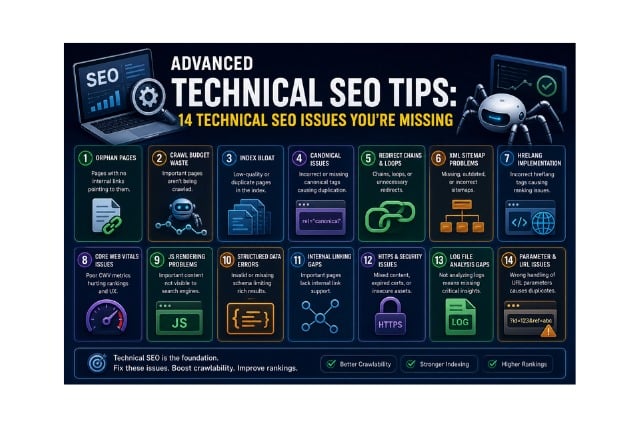
Advanced Technical SEO Tips: 14 Critical SEO Issues You’re Missing often explains why websites stay stuck even after good content work.
More so, technical SEO often decides whether your website grows or stays hidden. Many beginners focus only on content and backlinks, but they ignore deeper technical problems that sit under the surface. These hidden issues stop Google from fully understanding, crawling, and ranking your pages properly.
Advanced Technical SEO Tips: 14 Critical SEO Issues You’re Missing helps you identify those invisible barriers. Once you fix them, search engines can access your site better, understand the structure faster, and rank pages more accurately.
More so, this guide explains each issue in simple language so you can apply fixes even without deep technical experience.
Crawlability Problems That Block Your Pages
Search engines first need to crawl your website before they can rank anything. When crawlability fails, even great content stays invisible.
Many websites accidentally block important pages using wrong settings or a poor structure. Sometimes bots waste time on unimportant pages while missing high-value ones. So, this reduces ranking potential and slows down overall SEO growth.
Broken Internal Links
Broken internal links interrupt the crawling path across your website. When Googlebot hits a broken link, it loses navigation flow and may skip important pages. Over time, this reduces index coverage and weakens site authority.
In addition, fixing broken links improves crawl efficiency and helps distribute link equity properly. You can regularly audit your site using SEO tools and update or redirect broken URLs to relevant pages.
Poor Site Structure
A weak site structure confuses both users and search engines. When pages are not logically grouped, Google struggles to understand which pages matter most.
A strong structure follows a clear hierarchy: homepage → categories → subpages. So, this setup improves indexing speed and helps search engines assign authority correctly. It also improves user navigation, which increases engagement signals.

No Tech Jargon. Just More Customers.
We aren’t here to hide behind abstract technical metrics to mask a lack of results. Most agencies use complex algorithmic jargon just to confuse you and justify overcharging. JoseOne enjoys literally 100% client retention because, nothing is expensive when it’s worth what you pay for it.
Indexing Issues That Stop Visibility
Crawling does not guarantee indexing. Google may crawl your pages, but still decide not to index them if signals are unclear or conflicting.
Furthermore, indexing issues often come from technical mistakes like incorrect tags, duplicate content, or weak page value. These issues directly reduce your visibility in search results.
Noindex Tags on Important Pages
Sometimes developers or plugins accidentally apply noindex tags to important pages. So, this tells Google to ignore the page completely.
Therefore, removing incorrect noindex tags allows pages to re-enter search results. After fixing, you should request re-indexing through Google Search Console to speed up recovery.
Duplicate Content Confusion
Duplicate content creates confusion for search engines because they do not know which version to rank. So, this often happens with category pages, filters, or copied content.
More so, using canonical tags and rewriting similar pages helps solve this issue. Unique content signals improve ranking stability and prevent keyword cannibalization.
Site Speed and Performance Problems
Site speed directly affects user experience and SEO rankings. Slow websites lose visitors quickly, and search engines notice this behavior.
Thus, large images, unoptimized code, and weak hosting often cause slow performance. These issues reduce engagement and increase bounce rates, which harms rankings.
Improving speed requires compressing images, using caching systems, and reducing unnecessary scripts. Faster sites usually perform better in both desktop and mobile search.
Mobile Usability Issues_ Advanced Technical SEO Tips: 14 Critical SEO Issues You’re Missing
Most users now browse through mobile devices, so mobile optimization is no longer optional.
Besides, a poor mobile experience leads to low engagement and weak rankings. Common issues include small buttons, unreadable text, and layout shifts.
A responsive design automatically adjusts content to different screen sizes. So, this improves usability, keeps users longer on your site, and strengthens mobile SEO performance.
Technical On-Page SEO Mistakes
On-page SEO is not only about keywords; it also includes structure and technical setup.
Missing title tags confuse search engines and reduce click potential. Weak meta descriptions lower engagement from search results. Poor heading structure also makes the content harder to understand.
Thus, a clean on-page setup helps search engines interpret content correctly and improves visibility in SERPs.
URL and Canonical Problems
URLs and canonical tags guide search engines to the correct page version. Mistakes here often create ranking issues.
Messy URL Structures
Long or unclear URLs reduce trust and make indexing harder. Clean URLs improve readability and help search engines understand page context faster.
Short, keyword-relevant URLs also improve click-through rates because they look more trustworthy in search results.
Wrong Canonical Tags
Incorrect canonical tags send mixed signals to Google. So, this may cause important pages to lose rankings or get ignored.
A correct canonical setup tells search engines which page is the main version, especially when similar content exists across multiple URLs.
XML Sitemap and Robots.txt Errors
Sitemaps and robots.txt files act like roadmaps for search engines. If they are wrong, crawlers get lost or blocked.
So, a missing sitemap slows down indexing, especially for new websites. A wrong robots.txt file can block entire sections of a site accidentally.
Keeping both updated ensures smooth crawling and faster indexing of important pages.
Structured Data and Schema Issues
Structured data helps search engines understand your content beyond text. Without schema markup, your pages may miss rich results like FAQs, ratings, or featured snippets. So, this reduces visibility and click potential.
A proper schema improves context understanding and increases the chances of enhanced search results.
Security and HTTPS Problems
HTTPS builds trust between users and websites. Search engines also prefer secure websites.
Moreover, sites without SSL certificates often face ranking disadvantages. Users also avoid insecure websites due to browser warnings. Installing SSL improves trust, security, and SEO performance together.
Redirect and Broken Page Issues
Too many redirects slow down crawling and reduce page speed. Broken pages also create dead ends for both users and search engines. So, this harms site quality signals and reduces rankings.
Fixing redirects and removing broken pages improves crawl flow and strengthens SEO health.
Core Web Vitals Problems
Core Web Vitals measure real user experience on your website. Slow loading, layout shifts, and delayed interactions reduce scores. These issues directly affect rankings in competitive search results.
Improving Core Web Vitals leads to better engagement and stronger SEO performance.
JavaScript SEO Issues
Heavy JavaScript can hide important content from search engines. So, if the content loads late, Google may not fully index it. So, this reduces visibility in search results.
Simplifying scripts or using server-side rendering helps ensure full content accessibility.
Internal Linking Problems
Internal links connect pages and distribute authority across your website.
Weak linking isolates important pages and reduces their ranking power. Strong internal linking improves crawl paths and user navigation. A smart linking structure boosts both SEO performance and user experience.
Content Rendering Issues
Some websites load content differently for users and search engines. So, if Google cannot see the full content, it may rank the page poorly. Proper rendering ensures full visibility during crawling. Fixing rendering issues improves indexing and ranking consistency.
Simple Affordable Rates
At JoseOne, we keep it simple. You don’t need a degree in search engine mechanics—you just need more traffic, more phone calls, and more sales. We offer one, fully-loaded package for just $3 per day, to get your business ranking higher on Google, with a 100% Money-Back Guarantee. We handle the technical heavy lifting so you can focus on running your business.
Frequently Asked Questions
What is technical SEO in simple words?
Technical SEO improves website structure so search engines can crawl and rank pages easily.
Why is technical SEO important?
It ensures search engines understand your website and index it correctly.
What is the most common technical SEO issue?
Slow site speed and broken links are among the most common problems.
Do beginners need technical SEO?
Yes, basic technical SEO helps every website perform better in search results.
How often should technical SEO be checked?
Regular audits every few months help maintain site health and rankings.
Conclusion
Lastly, technical SEO forms the foundation of every successful website. Without fixing hidden issues, even strong content cannot reach its full ranking potential.
Advanced Technical SEO Tips: 14 Critical SEO Issues You’re Missing highlights the problems that quietly block growth. Once you fix them, your website becomes faster, cleaner, and easier for search engines to understand.
Long-term SEO success always depends on strong technical health. It helps you build that foundation and maintain consistent search performance.