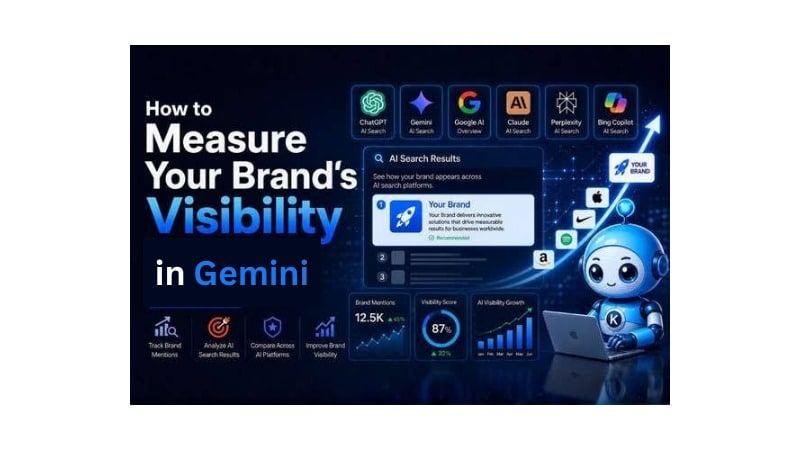
Did you know your brand could disappear from AI answers your customers see? How to measure your brand’s visibility in Gemini helps uncover where your brand appears and gets missed.
Modern buyers now use conversational tools when researching products, services, and business solutions online. Your brand can lose valuable attention when competitors receive stronger recommendations within these answers.
Today, AI search is changing how people discover brands and compare available options. Many users ask Gemini questions instead of browsing several traditional search result pages. That shift creates another important place for brands to build trust and visibility.
However, traditional rankings cannot show how often Gemini mentions your company. Marketers need clear methods for measuring mentions, citations, competitors, prompts, and answer quality.
Furthermore, AI visibility requires a different approach than traditional search performance measurement. A website can rank well while receiving limited attention from AI-generated answers. Measuring conversational visibility helps reveal these hidden opportunities and potential weaknesses. So, this guide explains useful metrics, testing methods, competitor analysis, citation tracking, and reporting.
What Does Brand Visibility in Gemini Mean?
Brand visibility in Gemini means your company appears within generated answers. Gemini may use information from different online sources when creating responses. Those sources can influence recommendations, descriptions, comparisons, and other information shown to users.
A brand mention means Gemini includes your company name within its response. A citation connects information with a website or another referenced online source.
Both signals matter because they reveal different parts of brand visibility. Mentions can increase awareness during early stages of customer research. Citations can create opportunities for users to visit relevant website pages. Strong visibility requires more than appearing once within an isolated response.
Traditional search rankings measure webpage positions for specific search queries. Conversational systems create answers using information from several available sources.
Users may receive direct recommendations without opening traditional search result pages. Measuring both channels gives marketers a broader view of digital visibility.
Why Measuring Gemini Visibility Matters for Your Brand
Consumers increasingly use conversational tools to research products and compare competing services. They may ask for software recommendations, service providers, products, or industry solutions.
Brands missing from those answers can lose opportunities before customers reach their websites. Competitors can gain attention simply by appearing within relevant AI recommendations.
Traditional SEO metrics cannot capture every impression created through conversational search experiences. Keyword rankings show webpage positions but cannot reveal every AI recommendation.
Website analytics also miss users who see your brand without clicking immediately. AI visibility measurement fills part of that important measurement gap.
Competitor visibility provides another useful layer for strategic marketing decisions. A competitor may appear across several valuable prompts while your brand remains absent.
Tracking those differences reveals topics where competing brands hold stronger visibility. Such findings can guide content planning, digital PR, and brand authority efforts.
Key Metrics for Measuring Gemini Brand Visibility
Several metrics can help marketers understand how Gemini represents their brands. Using consistent measurements makes changes easier to compare across different testing periods. Each metric provides a different view of your overall AI presence.
Brand Mention Rate and Citation Rate: How to Measure Your Brand’s Visibility in Gemini
Brand mention rate measures how often your company appears across tested prompts. Citation rate measures how often Gemini connects answers with your website.
A strong mention rate can indicate useful brand recognition within AI responses. A strong citation rate can create more opportunities for website visits.
Besides, tracking both metrics prevents marketers from relying on incomplete visibility information. Your brand might receive many mentions while gaining very few citations.
Another brand might receive fewer mentions but stronger citations from valuable sources. Comparing both signals creates a more useful visibility picture.
Generative Share of Voice
Generative share of voice compares your brand appearances against competitor appearances. Marketers can run identical prompts across several competing brands for comparison. The resulting data shows which brands receive more visibility across target topics. Tracking share of voice also highlights important gaps within competitive search areas.
A brand may perform well for branded prompts but poorly elsewhere. Non-branded prompts can reveal whether customers discover your company naturally. Comparing prompt categories creates deeper insight into broader market visibility.
Brand Position and Recommendation Depth
Brand position measures where your company appears inside generated responses. Brands mentioned near the beginning may receive stronger attention from readers.
Brands appearing later may receive less attention during quick research sessions. Recording position creates another useful measurement beyond simple brand mentions.
Recommendation depth shows how strongly Gemini presents your company to users. Gemini might recommend your brand as a leading choice or useful alternative. It might also mention your company only as background information. Separating these levels makes visibility reports more meaningful.
Brand Sentiment and Description Accuracy
Brand sentiment shows whether Gemini describes your company positively, neutrally, or negatively. Description accuracy checks whether generated information matches your actual business details. AI responses can sometimes contain outdated, incomplete, or incorrect brand information. Regular monitoring helps marketers identify those problems before they affect customer understanding.
Accurate descriptions support consistent messaging across important digital channels. Incorrect product details can create confusion during important buying decisions. Monitoring generated answers helps identify information that needs correction or clarification.
How to Build a Real-World Prompt Test Set
Start with questions that real customers might ask about your industry. Sales conversations can reveal common concerns, product questions, and comparison topics. Customer support requests can also provide useful examples for prompt creation. Website search data can reveal additional questions worth testing inside Gemini.
Organize prompts according to different customer search intentions. Informational prompts explore problems, definitions, guides, and industry questions. Comparison prompts ask Gemini to evaluate different products or competing companies. Recommendation prompts ask Gemini to suggest specific brands, services, or solutions.
Branded prompts should also form part of the testing process. These prompts show how Gemini describes your company when users ask directly. Non-branded prompts reveal whether Gemini recommends your brand without receiving its name. Combining both types provides broader insight into brand discovery.
Thus, refresh your prompt library as customer needs and industry topics change. New competitors, products, services, and trends can influence search behavior. Regular updates keep the measurement process relevant and useful.
How to Measure Your Brand’s Visibility in Gemini
Begin by creating a fixed list of prompts representing your target audience. Keep the wording consistent during each measurement cycle for reliable comparisons. Changing prompts without recording those changes can affect your performance conclusions.
Next, enter the selected prompts into Gemini and record every response. Save complete responses instead of recording only whether your brand appeared. Full responses provide context for recommendations, citations, competitors, and descriptions.
Then, record the main visibility signals from every tested response:
- Brand mention or absence
- Website citation or referenced source
- Brand position within the response
- Recommendation strength
- Competitor appearances
- Sentiment and description accuracy
Afterward, compare your brand appearances across all tested prompts and categories. Calculate mention rates, citation rates, and share of voice for useful reporting. Compare these results with earlier testing cycles to identify meaningful changes.
Finally, repeat the process according to a consistent measurement schedule. Repeated testing provides stronger evidence than relying on individual AI responses. Consistent data can reveal trends that isolated answers cannot explain.
Step-by-Step Process for Testing Gemini Visibility
Begin with a clean and consistent testing environment during every measurement cycle. Personal history, account settings, location, and language can influence generated responses. Keeping these factors consistent makes comparisons more useful.
Record the exact prompt used during every test and measurement period. Avoid changing wording unless the variation becomes part of your testing plan. Small wording changes can produce different answers and affect visibility results.
Next, capture every relevant brand and competitor appearance inside each response. Record citation URLs whenever Gemini provides sources connected with generated information. Save unusual responses because they may reveal accuracy or reputation issues.
Then, group results according to search intent and topic category. Separate informational, comparison, recommendation, and branded prompts during analysis. Such grouping helps identify specific areas of strength and weakness.
Finally, compare results across several testing cycles before making major decisions. AI responses can change, so one response cannot represent complete visibility. Repeated measurements provide stronger evidence of meaningful performance trends.
Competitor Intelligence and AI Visibility Gaps
Competitor tracking adds valuable context to brand visibility measurement. Your brand may appear frequently while competitors dominate important customer prompts. Measuring both sides shows where your company stands within competitive AI visibility.
Track competitors appearing alongside your brand across commercial and informational prompts. Record the topics where competitors receive recommendations while your brand receives limited visibility. Those gaps can reveal opportunities for stronger content and broader brand authority.
Review websites and sources connected with competitor appearances for useful patterns. Sources may include industry publications, review platforms, directories, news websites, and specialist resources. Understanding these sources can reveal potential opportunities for outreach and reputation building.
Competitor analysis therefore supports more focused content and digital marketing decisions. It shows where competitors gain visibility and where your brand needs stronger signals.
Citation Analysis: Finding Trusted Content Sources
Citation analysis helps identify sources that influence Gemini answers across tested prompts. Collect cited URLs and group them according to source type and topic. Repeated citations can reveal sources that provide useful information within particular industries.
Compare cited pages against similar pages that receive fewer citations. Review their structure, factual clarity, headings, supporting information, and useful answers. Clear content can make important information easier for AI systems to understand.
Updating outdated pages can improve their usefulness for customers and search systems. Add accurate facts, current product information, expert insights, and clear explanations. Strong content should answer customer needs instead of focusing only on keywords.
Third-party sources can also influence how Gemini understands your company. Relevant reviews, industry publications, directories, and news coverage can strengthen broader brand information.
Connecting Gemini Visibility With Traffic, Leads, and Revenue
AI visibility becomes more valuable when marketers connect it with business outcomes. Start by checking referral traffic from identifiable AI-related sources within analytics. Review landing pages connected with those visits and measure user engagement.
Track important actions such as inquiries, sign-ups, purchases, and consultation requests. These actions help connect visibility with measurable business performance. However, direct referral traffic cannot capture every influence from AI recommendations.
Some customers may see your brand inside Gemini before searching for it later. Branded search trends can provide another useful signal during performance analysis. Customer surveys can also reveal discovery paths that analytics platforms cannot capture.
Combining quantitative and qualitative data creates a stronger picture of AI visibility’s impact. Such analysis can help marketing teams justify continued measurement and optimization efforts.
Manual Spreadsheets vs. Automated AI Measurement Tools
Manual tracking works well for smaller prompt sets and early testing programs. Marketers can enter prompts, record responses, calculate mentions, and compare competitors. Direct review also helps analysts notice wording, sentiment, and unusual recommendations.
Automated platforms support larger prompt libraries and repeated testing across many queries. They can track mentions, citations, competitors, sentiment, and visibility trends. Automation can save time when teams need frequent measurements across large datasets.
A combined approach can provide stronger coverage for growing marketing programs. Automated tools can manage large datasets and repeated measurements. Manual reviews can examine important responses and unexpected changes.
The right measurement method depends on prompt volume, resources, and reporting needs. Smaller programs can begin manually before introducing automation at a greater scale.
Advanced Measurement: Managing AI Output Variance
Gemini responses can change even when users enter identical prompts. Conversational systems may produce different wording, recommendations, and source selections. Such variation makes single-response measurement less reliable for strategic decisions.
Repeated testing can reduce the influence of unusual individual responses. Run important prompts multiple times and compare results before identifying major trends. Group prompts by intent, topic, product category, and audience.
Regional and language differences can also influence generated answers. Brands serving multiple markets should test important prompts across relevant regions. Model changes can create another source of performance variation.
Record major system changes alongside visibility reports whenever possible. Comparing those changes with performance data can improve interpretation of sudden visibility shifts.
Actionable Ways to Improve Your Brand’s Presence in Gemini
Improving AI visibility starts with clear, useful, and reliable information. Content should answer real customer questions instead of focusing only on keyword placement.
Useful actions include:
- Create clear content answering common customer questions.
- Keep important product information accurate across websites.
- Maintain consistent brand details across trusted directories.
- Earn relevant mentions from respected industry publications.
- Maintain accurate profiles across important review platforms.
- Update older pages with fresh facts and expert insights.
Third-party sources can strengthen the information surrounding your brand online. Reviews, publications, directories, and industry websites can support broader brand recognition. Consistent business information also helps reduce confusion across different sources.
Monitor competitor citation sources to identify useful content opportunities. A competitor appearing through an important publication may reveal a valuable outreach target. Existing pages also deserve regular review and improvement.
Common Measurement Mistakes to Avoid
Testing only a few prompts can create misleading visibility conclusions. A small sample may not represent the questions your customers actually ask. Broader prompt coverage creates a more useful picture of AI visibility.
Ignoring competitors creates another common measurement problem. Brand visibility becomes more meaningful when competing companies receive identical testing conditions. Comparing results can reveal where your brand needs greater attention.
Tracking mentions without citations can also hide important performance differences. A brand may appear frequently while receiving few opportunities for website visits. Both signals should remain part of the measurement framework.
Relying on one response can produce false conclusions about long-term visibility. AI answers can change because sources, context, and system behavior change. Repeated testing provides stronger evidence for strategic decisions.
Traditional SEO tools also cannot provide the complete AI visibility picture. Rankings, traffic, and backlinks remain useful, but conversational measurement adds another important layer.
Frequently Asked Questions
What metrics should marketers use for Gemini visibility?
Marketers can track mentions, citations, share of voice, position, sentiment, and accuracy. These metrics provide different views of overall brand visibility.
How does Gemini visibility differ from traditional search rankings?
Traditional search rankings show webpage positions for specific queries. Gemini creates conversational answers using information from multiple available sources.
Why can Gemini provide different answers for identical prompts?
Generated responses can change because AI systems process context and changing information. Probabilistic response generation can also create different wording and recommendations.
Can Gemini visibility influence website traffic and leads?
Yes, citations can create referral visits, and recommendations can influence later searches. Tracking both direct and indirect signals provides stronger performance insight.
How often should marketers measure Gemini brand visibility?
A regular testing schedule helps identify meaningful changes across important customer prompts. Monthly reporting can provide useful visibility trends for broader marketing decisions.
At Last Words
To sum up, measuring AI visibility requires more than checking whether Gemini mentions your company. A strong process tracks mentions, citations, competitors, position, sentiment, prompts, and business outcomes.
Repeated testing provides better insight than relying on individual generated responses. Competitor analysis also shows where your brand gains visibility and where opportunities remain.
Build a useful prompt library, record complete responses, and compare results over time. How to measure your brand’s visibility in Gemini becomes easier through consistent and practical measurement.