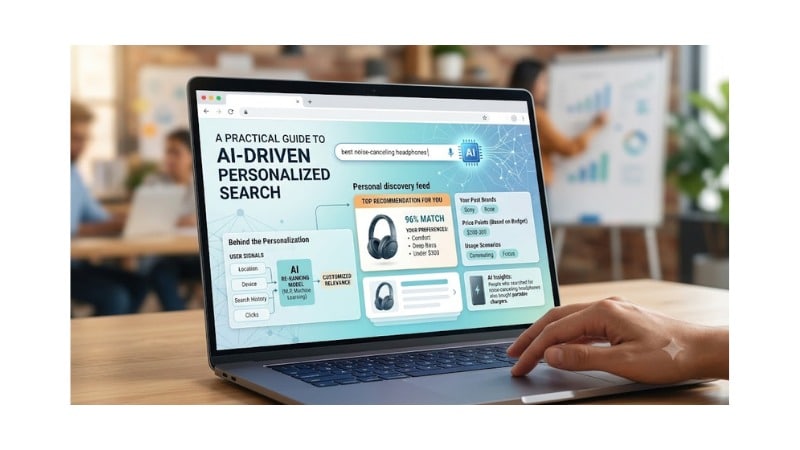
Have you ever spent hours looking for simple answers online? In the past, traditional search engines treated every user the same way. Did you know that modern search tools can now predict your exact needs before you finish typing?
More so, a practical guide to AI-driven personalized search shows how smart search turns simple queries into personalized answers. Explore it to master modern search systems today!
In addition, finding exact details on the internet often feels hard and slow. Classic search tools match exact words on a page. They ignore your personal preferences and daily habits.
Smart platforms solve this issue by reading live data and real context. They deliver personalized search results to every user. Businesses need smart tools to connect with active users. Modern users want fast answers and clear results without extra work.
By learning how AI-driven personalized search works, teams build better digital experiences. Read this practical guide to understand how smart systems turn raw data into helpful discovery journeys for everyone.
What Is AI-driven Personalized Search & Why It Matters Today
Smart search systems study user habits to show custom content. Traditional tools look only at exact word matches. Modern engines study your past clicks, location, and active device. They change result pages in real time to match your unique needs.
First, people want fast answers when they open a search bar. Static search tools show the same links to every person. Smart platforms adapt to changing user needs. They reduce zero-result pages and bring greater clarity to digital discovery.
Online platforms need strong tools to keep users happy and active. Tailored results make websites easier to explore for beginners and experts. By focusing on personal context, platforms build trust and create strong daily engagement across every channel.
Core Mechanics: How AI Understands Intent and Behavior in Real Time
Understanding search intent forms the heart of modern discovery systems. Smart search engines look far beyond basic words typed into a search box. They analyze full query structure, user intent, and active context. The process helps systems deliver accurate content every time.
Furthermore, every click and scroll tells a clear story about user needs. Systems track live clicks, active filters, and page reading time. Teams run user behavior analysis to map user paths. These insights help search engines improve search suggestions.
Predictive tools use machine learning search models to forecast user needs. These models spot hidden patterns across millions of daily actions. They sort results so users find the best answers with fewer clicks.

No Tech Jargon. Just More Customers.
We aren’t here to hide behind abstract technical metrics to mask a lack of results. Most agencies use complex algorithmic jargon just to confuse you and justify overcharging. JoseOne enjoys literally 100% client retention because, nothing is expensive when it’s worth what you pay for it.
The Technology Stack: Semantic Search, Vector Tools, and Language Models
Modern engines rely on natural language processing to understand complex phrases. The technology helps computers understand tone, grammar, and word meaning. It turns human language into structured data that systems process within milliseconds.
However, semantic search converts text into mathematical values called vector embeddings. These vectors place similar concepts close together in digital space. When users type a query, the engine finds matching concepts instead of matching characters alone.
Deep learning tools and knowledge graphs connect facts across large databases. They group related concepts, names, and places into clear visual nodes. These systems help modern platforms deliver accurate answers to difficult, multi-part questions.
Fueling the Engine: Data Signals That Power Personalization
Explicit data points give search systems strong baseline information about users. These signals include chosen language, account settings, saved location, and self-reported interests. Systems use static profiles to filter irrelevant content from the start.
Thus, implicit signals reveal user interests through live site activity. Systems record hover time, item views, and purchase history. These actions give search engines real context during an active session.
Signal Type | Examples | Primary Benefit |
Explicit Data | Language settings, saved location, profile preferences | Sets clear account boundaries and baseline relevance |
Implicit Data | Live clicks, scroll depth, session duration | Captures immediate context and changing user intent |
Technical Data | Device type, connection speed, browser platform | Optimizes layout delivery and search speed |
Furthermore, data pipelines stream user events into feature stores. Continuous feeds update user profiles without causing delays. Data flow helps search results match fresh user actions.
Key Business Benefits & Impact Across Major Industries
Smart search systems boost business success and support sales growth. Better results increase click rates, raise conversion metrics, and expand average order values. Platforms that value discovery turn casual visitors into loyal long-term buyers.
- E-Commerce: Show target items faster to shorten buyer journeys.
- Media & Entertainment: Suggest fresh videos based on personal watch history.
- Healthcare: Deliver accurate medical articles that match user reading levels.
- Enterprise Knowledge: Help staff locate internal documents within seconds.
Meanwhile, tailored discovery creates an outstanding search experience across web and mobile apps. Users find valuable content faster and feel understood by the platform. Smooth interactions reduce bounce rates and encourage users to return.
AI-driven Personalized Search vs Traditional Search
Traditional search engines rely on simple keyword rules and fixed databases. They return identical link lists to every user, regardless of personal background. Outdated methods produce generic results and frustrate users during their searches.
Modern platforms use dynamic re-ranking to deliver personalized, high-speed discovery. They process user context with standard keyword matches. The hybrid approach combines keyword precision with deep semantic understanding for greater accuracy.
Besides, scaling traditional search requires manual effort to maintain static rules. AI platforms learn from fresh user data without manual updates. These systems handle large query volumes while maintaining fast response times and cost efficiency.
How to Implement Smart Search Infrastructure: A Practical Guide to AI-driven Personalized Search
Building a modern search platform requires clear planning and solid data pipelines. Product teams gather clean event data before selecting advanced AI models. Following a clear deployment roadmap supports smooth integration without disrupting existing services.
Define Strategy and Goals
- Identify target metrics like conversion rates, click rates, and search speed.
- Build data collection rules that follow global privacy standards.
- Select vector databases that support hybrid keyword and semantic search.
- Set up live event pipelines to update user profiles during active sessions.
- Deploy re-ranking models that adjust results based on session context.
Simple Affordable Rates
At JoseOne, we keep it simple. You don’t need a degree in search engine mechanics—you just need more traffic, more phone calls, and more sales. We offer one, fully-loaded package for just $3 per day, to get your business ranking higher on Google, with a 100% Money-Back Guarantee. We handle the technical heavy lifting so you can focus on running your business.
Choose Models and Engine Tools
Engineers evaluate ready-made AI search tools against custom-built pipelines. Cloud frameworks provide pre-trained models that save development time and resources. Custom vector setups offer greater flexibility for specialized industry platforms.
Test, Deploy, and Refine: A Practical Guide to AI-driven Personalized Search
Teams test new search setups through side-by-side A/B comparisons. Monitor key metrics like search success rate, time to results, and user retention. Ongoing testing fine-tunes model performance and keeps results aligned with business goals.
Leading Tools and Platforms for Custom Discovery
Cloud platforms offer robust search infrastructure for growing businesses. Google Cloud Vertex AI Search and Microsoft Azure AI Search provide scalable vector tools. Managed services handle complex machine learning models with minimal setup.
Specialized search providers deliver turnkey tools for fast web deployment. Algolia AI Search and Coveo specialize in real-time personalization for online stores. Their dashboards let teams adjust ranking rules with ease.
However, open-source search engines like Elasticsearch and OpenSearch now support native vector search. Developers combine classic keyword indexes with custom vector embeddings on one platform. Its flexibility helps engineering teams build tailored search solutions in-house.
Critical Challenges, Ethics, and Common Pitfalls
Data privacy rules demand user consent and safe data handling practices. Companies handle personal information with care to comply with legal requirements like GDPR. Anonymous user profiles protect privacy while preserving search quality.
Over-personalization traps users inside restrictive filter bubbles. When algorithms show familiar content, users miss fresh ideas and new opportunities. Search teams introduce diverse results to keep discovery open and balanced.
Thus, the cold start problem affects new users and unindexed items. Without historical data, personalized search engines struggle to rank content accurately. Platforms address this challenge by using context signals like location and trending topics.
Measuring Success: Relevance Metrics and Performance KPIs
Engineers track technical relevance using established information retrieval formulas. Metrics like mean reciprocal rank measure how quickly top results appear for users. Normalized Discounted Cumulative Gain evaluates overall result quality.
Product managers track business KPIs to measure real-world impact. Important metrics include conversion rates, click-through rates, and average session time. High search success rates show users find valuable content with little effort.
A/B testing provides clear evidence when comparing search upgrades with legacy systems. Teams send live traffic to both engines to measure user engagement. Data analysis helps search updates support genuine business goals.
The Future: Generative AI, Multimodal Input, and Hyper-Personalization
Generative search combines conversational AI models with direct database retrieval. Instead of simple link lists, systems create clear answers that match user context. The approach turns traditional search bars into intelligent assistants.
Multimodal search allows users to combine text, images, voice, and video in one query. A shopper uploads a shirt photo and requests matching pants in the correct size. Search engines process visual inputs with personal preferences.
Ultimately, on-device AI processing brings hyper-personalized search to smartphones. Local models process sensitive user data without sending information to cloud servers. The shift delivers fast search while protecting user privacy.
Frequently Asked Questions
What is the main goal of smart search tools?
Smart search tools give every user helpful results based on personal habits, past actions, and context. Instead of showing static links, the engine adapts to match each person’s needs.
How do smart systems understand user intent?
Systems analyze context clues like location, device type, search history, and live clicks. Advanced algorithms process these signals to understand the meaning behind search queries.
Can small websites and online stores use smart search tools?
Digital products of every size can use smart search platforms. Cloud providers offer ready-to-use search engines that help small businesses deliver personalized discovery without building AI tools from scratch.
Does custom search affect user privacy?
Custom search relies on user data, but leading platforms protect information with care. Strong privacy safeguards, anonymous records, and global privacy laws help maintain user trust.
How does smart search help businesses grow?
Smart search helps users find products and information with less effort. Better discovery increases conversion rates, raises average order values, and builds long-term customer loyalty.
At Last Words
To sum up, smart personalized search changes how people discover information online. Modern engines read user intent and context to deliver custom results for every user.
These advanced search systems help companies improve engagement, save users time, and grow digital products. Read a practical guide to AI-driven personalized search to build modern search experiences for your platform today!