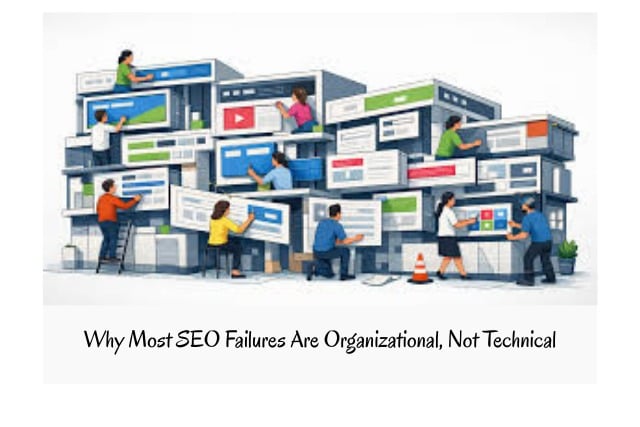
Are you struggling to see results from SEO and wondering why? Why Most SEO Failures Are Organizational, Not Technical explains that technical fixes alone rarely solve ranking problems.
Most businesses fail because of misaligned teams, poor processes, and a lack of leadership support. Understanding these challenges is key to real SEO success.
Therefore, many companies invest heavily in technical SEO, fixing errors, improving site speed, and optimizing meta tags. Yet, rankings often stay flat. The reason is not technical—Why Most SEO Failures Are Organizational, Not Technical.
Organizational factors like team misalignment, poor workflows, unclear goals, and leadership gaps usually cause SEO failure. When SEO becomes a shared responsibility across teams with clear processes and communication, results improve dramatically.
So, this guide helps beginners understand organizational challenges and gives experts strategies to align teams for better performance. It stems from hidden friction in decisions and ownership. Companies chase tools while ignoring people’s issues every day.
Organizational SEO challenges block progress before traffic drops. SEO team alignment breaks down in the early stages. Cross-department SEO strategies fail without strong ties.
Moreover, technical SEO limitations appear only after organizational problems grow. SEO leadership impact shapes every plan from the start. Teams blame updates instead of internal gaps. It demands a shift in focus now.
The Hidden Truth: SEO Declines Start with Organizational Issues, Not Code
First, SEO performance drops months before metrics reveal the decline. Teams lack clear ownership of CMS templates and elements. Departments compete over priorities in daily operations.
Teams implement changes without any SEO evaluations or reviews. Friction accumulates inside the company over time. Technical solutions arrive too late to reverse damage.
Understanding the Real Reasons SEO Fails: Organizational vs Technical
Technical issues surface in reports and audits for everyone. Organizational challenges remain concealed in routine tasks and interactions. Teams devote hours to tools and diagnostics each week.
Next, they overlook fixes for people and procedures in plans. Misalignment generates higher costs than faulty code does. SEO process optimization requires attention to both aspects equally.
How Company Structure and Placement Sabotage SEO Success
SEO occupies the incorrect department in many organizations. Marketing controls it initially, then IT assumes responsibility later. Product teams disregard search requirements in their workflows.
Decision-makers favor alternative objectives over SEO goals. Communication breakdowns hinder progress in every initiative. Cross-department SEO strategies collapse without robust connections between groups.

No Tech Jargon. Just More Customers.
We aren’t here to hide behind abstract technical metrics to mask a lack of results. Most agencies use complex algorithmic jargon just to confuse you and justify overcharging. JoseOne enjoys literally 100% client retention because, nothing is expensive when it’s worth what you pay for it.
Common Organizational Mistakes That Cause SEO Failures
Furthermore, teams establish no defined goals or key performance indicators. Priorities conflict among groups every week. Resources flow toward immediate gains rather than strategy.
Agencies manage tasks without genuine internal accountability or oversight. Teams deploy changes without consulting SEO experts at all.
Department Conflicts and Silos That Sabotage Discoverability
Moreover, marketing demands attractive pages with rapid deployment times. IT halts modifications due to security concerns and protocols. Design emphasizes aesthetics above search optimization value. No team discusses potential impacts before launches.
Hiring Mistakes: The Early Warning Sign Teams Ignore
In addition, incorrect hires expose issues at the outset. Teams select specialists in tools lacking business acumen. New employees possess no power to resolve problems. Inadequate attitudes obstruct achievements over extended periods.
Why Technical SEO Limitations Cannot Solve Rankings Problems
Next, flawless code underperforms without a solid underlying strategy. Sites maintain impeccable technology yet achieve low rankings. Content overlooks user intent in every instance. User experience elevates bounce rates across visits. Alignment disappears among various teams and functions. Organizational SEO challenges overpower tools in every scenario.
Content, Workflow, and Leadership Barriers in SEO
Furthermore, content creators generate posts devoid of search orientation. Approvals consume weeks or even months in cycles. Delayed processes diminish the worth of fresh material. Leaders offer no substantial backing for SEO initiatives. Culture opposes experiments and modifications in approaches. SEO leadership impact weakens in these environments.
Content and SEO Collaboration_ Why Most SEO Failures Are Organizational, Not Technical
Additionally, writers disregard keyword investigations in their routines. SEO specialists operate outside content creation circles. No collective workflow for SEO success materializes. Teams forfeit opportunities to attain superior rankings.
Measuring SEO Success: Avoiding Organizational Pitfalls
Moreover, metrics monitor solely technical indicators in assessments. Business results receive no attention in evaluations. User interaction figures escape inclusion in analyses. Comprehensive tracking demands perspectives from multiple teams. SEO project management necessitates links to revenue metrics.
How Teams Can Align for Better SEO Performance
Next, teams develop cross-functional guides for consistent application. They disseminate information via regular training programs. Schedules remain practical for all participants involved. Duties are assigned to specific individuals with clarity. SEO team alignment strengthens through these practices.
- Teams conduct joint meetings to share insights weekly.
- They define roles to avoid overlaps and confusion.
- Groups establish feedback loops for continuous improvement.
Beginner Steps and Advanced Strategies to Fix Organizational SEO
Additionally, small enterprises begin with mapping out owners. They devise basic checklists for all modifications. Stakeholders participate in initial discussions and planning. Large corporations construct enterprise SEO governance frameworks. They perform alignment reviews every three months. Centralized operations assist groups with multiple brands.
Advanced Strategies for Large Enterprises and Multi-Brand Groups
Moreover, corporations define explicit decision authorities across geographic areas. Decentralized units adhere to unified operational guides. Routine reviews identify friction at initial stages. Enterprise SEO governance averts conflicts over keywords.
Simple Affordable Rates
At JoseOne, we keep it simple. You don’t need a degree in search engine mechanics—you just need more traffic, more phone calls, and more sales. We offer one, fully-loaded package for just $3 per day, to get your business ranking higher on Google, with a 100% Money-Back Guarantee. We handle the technical heavy lifting so you can focus on running your business.
Building an SEO-Friendly Organization for Lasting Success
Organizational transformations surpass technical adjustments in importance. Steps foster accountability and synchronization for expansion. Why Most SEO Failures Are Organizational, Not Technical concludes with essential insights here. Repair organizational SEO challenges as the primary action.
SEO team alignment propels authentic advancement in rankings. Workflow for SEO success demands precise procedures throughout. SEO leadership impact influences each result profoundly. Content and SEO collaboration elevates performance levels. Cross-department SEO strategies eliminate isolated operations.
Technical SEO limitations diminish under effective systems. Enterprise SEO governance expands victories at scale. SEO project management connects to organizational objectives.
Moreover, emphasize individuals and choices in daily routines now. Teams observe improved positions across search engines. Organizational concerns evaporate through dedicated initiatives.
Companies excel in search engine outcomes consistently. Sustain alignment robustly each month without fail. Triumph accumulates gradually through consistent efforts. Your SEO develops firmness and reliability over time.
Furthermore, Why Most SEO Failures Are Organizational, Not Technical terminate at this point. Brands execute corrections without delay in operations. Outcomes emerge in visitor numbers and conversions.
Maintain transparency in all aspects. Victories accompany beneficial alterations in practices. Your website will ascend in rankings soon.
Frequently Asked Questions
What triggers the majority of SEO failures within companies?
Organizational matters such as ownership voids and silos trigger most failures. Technical concerns manifest later in sequences.
Why do technical corrections fail to rescue SEO efforts?
Technical corrections fail in the absence of organizational backing in place. Teams require synchronization and leadership endorsement first.
How does leadership influence outcomes in SEO?
Leadership influences SEO outcomes through priority establishment. Robust endorsement advances sustained accomplishments.
What assists small enterprises in evading SEO traps?
Small enterprises evade traps via distinct owners. Straightforward procedures and objectives function optimally.
How can major corporations enhance SEO scaling?
Major corporations enhance SEO scaling with governance structures. Periodic reviews maintain team synchronization.
Conclusion
Lastly, SEO relies on elements beyond coding and instruments. Organizational SEO challenges impede the bulk of advancement. Why Most SEO Failures Are Organizational, Not Technical illustrates the genuine route ahead.
Finally, teams that remedy personnel matters secure substantial victories. Sync and hold generate enduring expansion. Commence with transparent choices today. Your SEO advances for the extended duration.