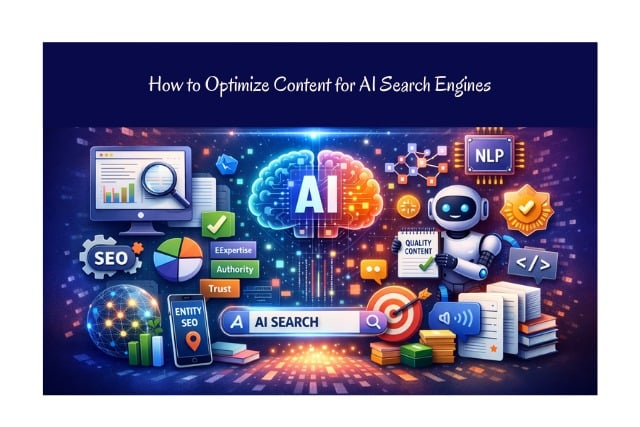
How to Optimize Content for AI Search Engines stands as the top skill for modern SEO wins. AI search engines pick what content to trust, cite, and display to users. You risk losing rankings, traffic, and visibility when you skip AI optimization.
AI search engines transform the way people find content online. Platforms such as Google AI Overviews, ChatGPT, Gemini, and Perplexity move beyond keywords alone. They examine meaning, intent, accuracy, and authority in depth.
Next, this guide shows you how to optimize content for AI search engines with tested SEO rules, entity optimization, structured data, and trust markers. You gain knowledge on how AI systems process content, what they value, and how your pages turn into trusted sources.
Furthermore, beginners and experts alike receive a full plan to craft content that AI search engines grasp, rank, and reference. You build skills to thrive in this new era.
Understanding AI Search Engines and Their Differences from Traditional Search
First, AI search engines differ from traditional ones in key ways. They employ advanced tech to deliver direct answers to users. Google AI Overviews takes the lead in this space. ChatGPT and Perplexity come right behind in popularity. These systems understand user intent with precision.
Meanwhile, the old search depends only on keywords for results. AI explores context to provide better insights. It draws facts from reliable sources across the web. Creators notice fewer clicks to their sites. AI summarizes information for quick user access.
Additionally, you observe the change without effort. AI prefers natural language in queries. Users pose lengthy questions in conversations. Search engines advance at a rapid pace. AI handles content through large models.
Moreover, these models train on vast data collections for accuracy. They prioritize relevance in their rankings. Grasp the basics: AI finds content via web crawls. It analyzes text for deeper meaning. Then, it elevates top-quality material.
The difference expands over time. Traditional search values backlinks above all else. AI focuses more on trust signals. Update your approach starting today for success.
Keyword Strategy and User Intent Mapping for AI Optimization
To begin, choose keywords with care for AI success. Research tools offer great support in this task. AnswerThePublic generates fresh ideas for queries. Semrush identifies current trends in search behavior. Target long-tail phrases that match spoken language.
People use these phrases in daily talks. Map user intent with clear steps. Identify informational needs at the start. Some users aim to purchase products. Others look for navigation guidance.
In addition, conversational queries increase in volume. Beginners focus on simple user desires. Experts forecast complex intents. Tools assist in mapping these intents. Semantic keywords provide extra layers of connection.
Moreover, they seamlessly link concepts. Position them in natural spots throughout. AI responds well to this method. Your content achieves higher ranks as a result. Experiment with various queries on a regular basis.
Observe what users search for most often. Modify your words to align with those patterns. You gain visibility in a short time. Maintain a natural tone at all times. Excessive keywords damage your flow.
Finally, balance delivers the best outcomes for everyone.

No Tech Jargon. Just More Customers.
We aren’t here to hide behind abstract technical metrics to mask a lack of results. Most agencies use complex algorithmic jargon just to confuse you and justify overcharging. JoseOne enjoys literally 100% client retention because, nothing is expensive when it’s worth what you pay for it.
Creating High-Quality, Trustworthy Content for AI Visibility
Above all, quality influences AI selections in search results. Writers base their work on solid facts. Validate every source before inclusion. Establish trust with genuine information. AI detects false claims in an instant.
Produce pieces at an expert level. They attract citations from other sources. Apply E-E-A-T as your main framework. Demonstrate experience in your chosen subjects. Support expertise with specific details.
Moreover, secure authority from industry peers. Gain trust through straightforward language. Content formats play a crucial role here. Evergreen guides endure over long periods. Data studies stand out with clarity.
Furthermore, tutorials guide users through processes step by step. Explainers simplify intricate topics for readers. Fresh content captures immediate interest from audiences. Combine these types for optimal impact.
Next, readers remain involved in your material. AI recognizes that strong attraction factor. Prioritize human readers in your writing. AI aligns with that focus in turn. Your unique voice emerges strong. Depth outperforms superficial content every time.
Front-Loading Key Information for Quick Responses in How to Optimize Content for AI Search Engines
To start, place key answers at the beginning of your content. Users seek immediate facts without delay. AI extracts these details first for responses. Keep sentence structures straightforward and clear. Engage readers from the very first line. Provide real value right in the opening sections.
Structuring and Formatting Content for Easy AI Parsing_ How to Optimize Content for AI Search Engines
First, a proper format allows AI to process content with ease. Employ headings to direct the overall flow. Subheadings divide sections into manageable parts. Bullet points present ideas. Numbered steps outline sequences of actions.
Moreover, tables display comparisons of data effectively. Steer clear of dense text blocks. Maintain short paragraphs for better readability. AI interprets logical structures without issues. Featured snippets benefit from this setup.
AI responses are sourced from these optimized areas. Include summaries of main points where needed. Connect ideas with smooth transitions. Readers navigate the content without confusion. Engagement levels rise as a result.
- Use bold text for emphasis on key terms.
- Incorporate white space to improve visual appeal.
- Align elements for consistent presentation.
- Test formats on multiple devices.
Using Short Paragraphs and Visual Aids Like Charts
To continue, short paragraphs enhance overall readability for users. They sustain attention throughout the reading experience. Include charts to illustrate data points. Visuals rapidly convey information.
- Select simple designs for charts.
- Label axes with clear descriptions.
- Choose colors that aid visibility.
- Integrate visuals within relevant sections.
Technical and Structured Data Optimization for AI Crawlers
Technical aspects hold significant importance for optimization. Ensure your site allows easy crawling by bots. Accelerate page loading times for better performance. Core Web Vitals impact user satisfaction levels. User experience retains visitors on your pages.
Moreover, intelligently apply schema markup. It assists AI in comprehending content details. Select appropriate types based on your topics. Execute them with accuracy for the best results. Entity SEO integrates well in this process.
Knowledge graphs connect related facts. JavaScript handles rendering in effective manners. Guarantee AI reaches all parts of your site. Mobile optimization delivers excellent views on devices. Perform tests to identify and correct issues.
Building Authority, Citations, and Topical Expertise
Over time, authority develops through consistent efforts. Secure mentions from established brands in your field. Backlinks contribute value in certain cases. AI citations elevate your content’s status. Partner with influencers in thoughtful ways.
Furthermore, credible sources strengthen your arguments. Depth ensures comprehensive coverage of subjects. Position yourself as the primary resource in your niche.
Leveraging Influencers and Reputable References
To expand, influencers distribute your content to wider audiences. They attract genuine viewers to your work. References support your statements with evidence. Trust increases as a direct outcome.
Entity Optimization for Contextual Relevance in How to Optimize Content for AI Search Engines
First, entities connect your content to broader concepts. AI identifies these links with clarity. Context introduces valuable layers to your material. Relevance improves your position in search results.
Incorporating Multimedia and Visual Elements in AI-Friendly Content
To enhance, multimedia adds richness to your creations. Optimize images to suit search requirements. Include descriptive alt text for accessibility. Captions offer additional explanations for viewers. Videos foster deep engagement with audiences.
Moreover, infographics condense information into digestible forms. Maintain balance in their usage. Engagement reaches new heights with these elements. AI identifies visuals in accurate ways. Guides to incorporate them for maximum effect. Tutorials demonstrate steps through live examples.
Measuring Performance and Tools for AI Search Analytics
First, monitor your achievements with intelligent methods. Citations reveal the true influence of your work. Visibility metrics direct your future actions. Tools such as Google Search Console assist. AI analytics explores data at deeper levels.
Moreover, checklists enable quick audits of content. Establish weekly reports for consistent tracking. A/B tests uncover effective strategies. Optimization loops refine processes on an ongoing basis. Sentiment analysis evaluates user reactions.
- Track daily changes in metrics.
- Compare performance across platforms.
- Adjust based on data insights.
- Share reports with your team.
Common Mistakes, Case Studies, and Real-World Examples
Often, errors hinder progress in optimization efforts. Excessive keywords disrupt natural content flow. Low-quality AI-generated content fails to engage. People overlook essential trust signals in their work. Study case examples to gain insights.
Successes from 2025 highlight effective paths. E-commerce platforms achieve growth through adaptation. Blogs regain their audience with targeted changes. News outlets adjust to new demands. Failures deliver valuable lessons for improvement. Correct them through simple adjustments.
Simple Affordable Rates
At JoseOne, we keep it simple. You don’t need a degree in search engine mechanics—you just need more traffic, more phone calls, and more sales. We offer one, fully-loaded package for just $3 per day, to get your business ranking higher on Google, with a 100% Money-Back Guarantee. We handle the technical heavy lifting so you can focus on running your business.
Future Trends in AI Optimization
Looking ahead, trends define the landscape of tomorrow. Voice search expands its reach among users. Personalized responses customize experiences for individuals. Regulations establish ethical standards in the field. Prepare for shifts expected in 2027.
Moreover, evolving large language models requires adaptable approaches. Strategies evolve to meet these demands.
Frequently Asked Questions
What does AI search engine optimization involve in practice?
AI search engine optimization involves crafting content that AI systems comprehend, trust, and reference through clear structures, robust contexts, precise data, and strong authority indicators.
How do AI search engines determine content rankings overall?
AI search engines evaluate content based on relevance levels, accuracy standards, topical authority measures, entity connections, and trust indicators such as EEAT principles.
Which content formats excel in AI search environments?
Long-form guides, instructional tutorials, research-based articles, and expert breakdowns succeed because they deliver depth and clarity to users.
How crucial is structured data in AI search contexts?
Structured data aids AI in grasping content contexts, authorship details, and relationships, which enhances visibility and increases citation opportunities.
How frequently should you update AI-optimized content pieces?
Review AI-optimized content every three to six months to maintain current facts, statistics, and references for relevance.
Conclusion
In summary, AI search engines redefine content ranking and discovery processes. Traditional keyword SEO falls short on its own. AI systems seek meaning, accuracy, structure, and authority in content.
You secure long-term visibility across search platforms, answer engines, and voice systems when you optimize content for AI search engines. Solid content structures, entity SEO for AI, trusted sources, and technical performance dictate outcomes.
Moreover, brands that embrace changes early dominate AI search results. Others who disregard them experience visibility declines. AI optimization forms the core of contemporary SEO practices.
AI search optimization paves the path to future achievements. Creators adopt an AI SEO strategy without delay. You apply steps to optimize for AI search in your work. AI content optimization yields tangible results for efforts.
Ranking in AI search engines requires dedicated commitment. Implement AI answer engine optimization techniques for gains. Entity SEO for AI links essential elements together. Structured data for AI search provides clear definitions.
Moreover, AI content ranking factors influence your decisions. EEAT for AI search establishes a firm foundation. Adhere to how to optimize content for AI search engines in your process. Success rewards those who take action now.
Finally, your content excels in AI-driven environments. Continue learning as technology advances further. How to optimize content for AI search engines remains vital for growth. Readers locate your work with ease. Victories accumulate gradually over periods.