Do you think stuffing your content with keywords will skyrocket your rankings? It might just destroy them instead. Keywords shape how websites rank on Google. Some people cram keywords to trick search engines.
Moreover, others use natural keyword usage to rank better. Keyword stuffing vs. natural keyword usage shows two SEO paths. One path hurts your site.
The other path helps it grow. Google spots bad tactics. Google rewards good ones. Want to optimize content without penalties?
Explore keyword stuffing vs. natural keyword usage. Learn the risks, benefits, and steps to succeed.
Understanding Keyword Stuffing in SEO
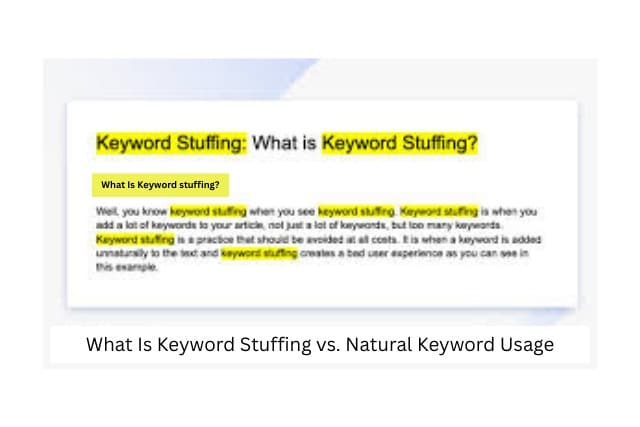
Start with what keyword stuffing means. People pack keywords into content to fool search engines. They repeat words like “best shoes” too often. They aim to rank higher. Content turns hard to read. Users leave fast. Google catches this.
In the U.S., about 60% of penalized sites in 2024 used keyword stuffing, per Search Engine Journal. Keyword stuffing breaks Google’s rules. It causes ranking drops. It causes site removal.
- People overuse keywords to manipulate rankings.
- Content loses clarity and user trust.
- Google’s algorithms flag unnatural patterns.
Stuffing Examples in Action_ What Is Keyword Stuffing vs. Natural Keyword Usage
Now, see how keyword stuffing works. Picture a page saying, “Buy cheap shoes, best cheap shoes, affordable shoes.” It sounds forced. Some hide keywords in white text on white backgrounds. Others jam keywords into meta tags or alt text.
A good page uses keywords smoothly. It reads like a chat. Keyword stuffing examples show why Google flags bad content. Clear writing beats stuffed content every time.
- Stuffed content repeats keywords without context.
- Hidden keywords try to trick search engines.
- Natural content flows and engages readers.

No Tech Jargon. Just More Customers.
We aren’t here to hide behind abstract technical metrics to mask a lack of results. Most agencies use complex algorithmic jargon just to confuse you and justify overcharging. JoseOne enjoys literally 100% client retention because, nothing is expensive when it’s worth what you pay for it.
SEO Effects of Keyword Stuffing
Next, grasp over-optimization risks. Google penalizes keyword stuffing. Your rankings drop fast. Users find stuffed content useless. They leave quick. Engagement suffers. You lose trust. You lose authority.
Organic traffic falls. Google’s algorithms, like SpamBrain, spot odd patterns. A penalty wipes out months of work. Avoiding Google penalties ensures long-term success. Keyword stuffing is a bad shortcut. It costs too much.
What Is Natural Keyword Usage?
Now, focus on natural keyword usage. Write content for people, not search engines. Use keywords in a real way. A blog might say, “Find the best shoes for running.” It fits the context. Google rewards this. Natural keyword placement keeps readers hooked.
More so, it builds trust. Your site ranks higher with problem-solving content. Natural keyword usage follows SEO content best practices. It’s the best way to optimize.
What Is Keyword Stuffing vs. Natural Keyword Usage: Key Differences
Compare keyword stuffing vs. natural keyword usage. Stuffing targets search engines. It repeats keywords without care. Natural usage targets readers.
It uses keywords with purpose. Stuffing skips context. Natural usage uses context. Keyword density in SEO matters here. Stuffing hits high density, like 5%. Natural usage stays low, around 1-2%. Semantic keyword usage adds depth with related terms. Natural writing flows and ranks better.
Simple Affordable Rates
At JoseOne, we keep it simple. You don’t need a degree in search engine mechanics—you just need more traffic, more phone calls, and more sales. We offer one, fully-loaded package for just $3 per day, to get your business ranking higher on Google, with a 100% Money-Back Guarantee. We handle the technical heavy lifting so you can focus on running your business.
How to Write Naturally Optimized Content
Want to master natural keyword usage? Follow these steps. Know your audience’s search intent. Write content that answers questions.
Use synonyms and LSI keywords, like “running shoes” or “athletic footwear.” Place keywords in titles, intros, and subheadings. Use “keyword optimization tips” in a heading. Keep sentences clear and short. Avoid over-optimization risks. Check keyword density with tools like Yoast. Write for humans. Google follows.
- Research keywords with Google Keyword Planner.
- Use LSI keywords for variety.
- Place keywords in the first and last 100 words.
- Keep keyword density below 2%.
- Write content that solves user problems.
- Check readability with Hemingway.
These tips ensure natural keyword placement. They boost rankings without penalties. Focus on quality. Google’s ranking factors reward helpful content. Beginners start here. Experts refine their approach.
Future of Keyword Usage in SEO
Look at SEO’s future. Google’s AI, like RankBrain and BERT, understands content better. It values search intent over keywords. Semantic keyword usage grows vital. Use related terms to show relevance.
A shoe blog might include “comfort,” “durability,” or “style.” Keyword count matters less. Quality content drives rankings. Writing SEO-friendly content means solving user problems. Stay updated with Google’s changes. Your site stays safe and strong.
Frequently Asked Questions
What does keyword stuffing mean in SEO?
People overuse keywords in content, meta tags, or alt text to trick search engines.
Why does keyword stuffing harm sites?
It creates a poor user experience, reduces readability, and triggers Google penalties.
What is a safe keyword density for SEO?
Aim for 1-2% density with natural flow, not forced keywords.
How do I write with natural keyword usage?
Focus on search intent, use synonyms, write clearly, and place keywords wisely.
Does AI content cause keyword stuffing?
AI content may overstuff keywords. Edit it for natural flow and relevance.
Final Thoughts
Lastly, master keyword stuffing vs. natural keyword usage for SEO success. Keyword stuffing triggers penalties and hurts your site. Natural keyword usage boosts rankings and trust. Write for people, not algorithms.
More so, use keywords in titles, intros, and content wisely. Follow SEO content best practices. Avoid Google penalties. Learn Google ranking factors. Your site grows. Stay honest. Your rankings thrive.