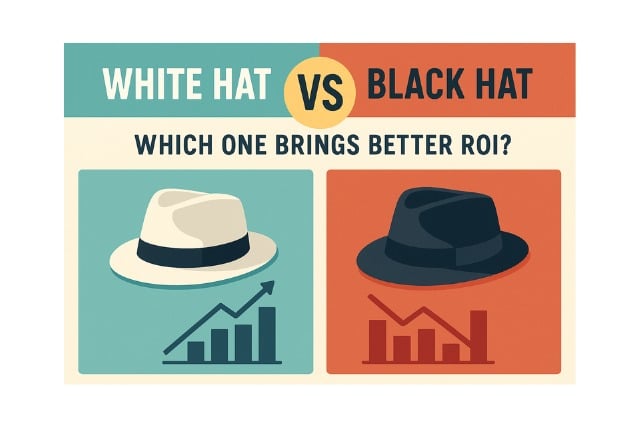
Which SEO strategy truly pays off—playing by the rules or bending them for quick wins? In the battle of White Hat vs. Black Hat SEO, ROI is the ultimate deciding factor.
In digital marketing, every click, lead, and conversion comes with a cost. That’s why ROI (Return on Investment) is the number one metric businesses use to judge whether their SEO efforts are worth it.
On one side, White Hat SEO focuses on ethical practices, high-quality content, and long-term trust. On the other hand, Black Hat SEO tempts with shortcuts, fast rankings, and risky tactics that could crash overnight.
More so, this guide breaks down both approaches, showing what they mean, how they impact ROI, and which strategy delivers sustainable results in 2025 and beyond. Whether you’re new to SEO or an expert weighing cost versus growth, this comparison gives you the clarity to invest wisely.
Why ROI Matters in SEO Strategies
First, ROI guides every smart business choice. SEO goes beyond ranking high. It turns clicks into revenue. A strong SEO plan grows traffic and conversions. In the U.S., businesses spend $80 billion annually on SEO. That’s a huge investment! You need to ensure your money delivers.
Comparing White Hat vs Black Hat SEO: Which One Brings Better ROI? helps you choose smartly. White Hat builds trust and steady growth. Black Hat chases fast gains but risks penalties. Understanding ROI keeps your strategy sharp and profitable.

No Tech Jargon. Just More Customers.
We aren’t here to hide behind abstract technical metrics to mask a lack of results. Most agencies use complex algorithmic jargon just to confuse you and justify overcharging. JoseOne enjoys literally 100% client retention because, nothing is expensive when it’s worth what you pay for it.
What Is White Hat SEO? (Beginner-Friendly Definition & Practices)
Now, let’s explore White Hat SEO. It follows search engine rules. Picture it as playing fair. You create quality content for users, not just Google. White Hat SEO techniques include:
- Keyword research: Find terms users search for.
- Fast-loading pages: Optimize images and code for speed.
- Honest backlinks: Earn links from trusted sites. For example, you write a blog that solves a problem. Or you improve site speed for a better user experience.
These steps build trust with users and search engines. Beginners can use tools like Google Keyword Planner. Experts leverage White Hat for sustainable SEO growth. It’s safe, ethical, and user-focused.
What Is Black Hat SEO? (Definition, Tactics, and Risks)
On the other hand, Black Hat SEO breaks rules. It tricks search engines for quick rankings. Common tactics include:
- Keyword stuffing: Overloading content with keywords.
- Hidden text: Hiding words to manipulate rankings.
- Fake backlinks: Using private blog networks for false authority. For instance, some cram keywords into content unnaturally. Others buy links from shady sources. Black Hat SEO risks include search engine penalties, like ranking drops or bans. Google’s algorithms detect these tricks fast. In 2023, 60% of U.S. sites using Black Hat faced penalties. Beginners might see quick wins, but experts know the danger. Black Hat harms long-term SEO strategies.
Key Differences_ White Hat vs Black Hat SEO: Which One Brings Better ROI
Next, let’s compare the two approaches. White Hat SEO prioritizes users. It builds trust and follows guidelines. Black Hat SEO targets algorithms with sneaky tactics. White Hat takes time but lasts longer. Black Hat delivers fast results but risks everything.
Ethical SEO practices in White Hat avoid penalties. Black Hat’s shortcuts lead to trouble. For example, White Hat earns backlinks through great content. Black Hat buys them from unreliable sources. Understanding these differences helps you choose the right path for ROI in digital marketing.
Short-Term vs. Long-Term SEO Gains: Which Wins?
Now, let’s focus on results. Black Hat SEO delivers short-term SEO gains. You might rank high in weeks. But those gains vanish fast. Google’s updates, like Penguin, crush sneaky tactics. White Hat SEO builds long-term SEO strategies.
It takes months but grows steadily. For example, a White Hat blog post drives traffic for years. Black Hat tricks, like cloaking, lead to bans. Long-term gains win for ROI. Why? They’re stable, safe, and cost less over time. Choose White Hat for lasting success.
The Cost Factor: Investment vs. Risk in SEO
Moreover, costs play a big role in White Hat vs Black Hat SEO: Which One Brings Better ROI? White Hat demands upfront effort. You invest in quality content, tools, and time. Expect to spend $500-$2000 monthly on solid SEO.
Black Hat seems cheaper initially. You might pay $100 for fake links. But penalties cost more. Recovering from a Google ban takes months and thousands.
White Hat’s investment fuels sustainable SEO growth. Black Hat’s risks drain your budget. Smart businesses choose steady growth over risky shortcuts.
How Search Engines React to SEO Tactics_ White Hat vs Black Hat SEO: Which One Brings Better ROI
Also, search engines shape SEO outcomes. Google favors White Hat SEO. Why? It rewards user-focused content. Fast sites and helpful blogs boost rankings. Black Hat faces search engine penalties. Algorithms like Panda detect keyword stuffing.
Penalties cause lower rankings or complete removal. Google’s 2024 updates hit Black Hat hard. Trust signals, like quality backlinks, help White Hat stand out.
Experts monitor algorithm changes to stay safe. Beginners should stick to ethical SEO practices. This keeps your site visible and trusted.
ROI Metrics That Matter: Measuring SEO Success
Furthermore, you must measure SEO ROI. SEO ROI measurement tracks traffic, leads, and sales. Use tools like Google Analytics for data. Key metrics include organic traffic, bounce rate, and conversions. For example, a White Hat site might gain 10% more conversions annually.
Black Hat spikes traffic but crashes after penalties. Calculate ROI by comparing costs to revenue. Did your $1000 SEO budget yield $5000 in sales? That’s strong ROI. Experts analyze cost-per-acquisition. Beginners start with simple traffic reports.
Simple Affordable Rates
At JoseOne, we keep it simple. You don’t need a degree in search engine mechanics—you just need more traffic, more phone calls, and more sales. We offer one, fully-loaded package for just $3 per day, to get your business ranking higher on Google, with a 100% Money-Back Guarantee. We handle the technical heavy lifting so you can focus on running your business.
Hybrid Approach: Exploring the Grey Hat SEO Approach
Interestingly, some choose a middle ground. Grey Hat SEO blends White and Black Hat. It’s not fully ethical, but it avoids outright cheating. For example, you might buy links carefully or tweak content slightly.
The Grey Hat SEO approach seems tempting for quick wins. But it still carries risks. Google might flag aggressive tactics. Beginners should avoid Grey Hat—it’s confusing.
Experts might test it, but prefer White Hat for safety. Grey Hat doesn’t ensure better ROI. It’s a gamble, not a strategy.
Which One Brings Better ROI in 2025 and Beyond?
Finally, let’s settle White Hat vs Black Hat SEO: Which One Brings Better ROI? White Hat wins for long-term success. It builds trust, avoids penalties, and grows steadily. Black Hat’s short-term SEO gains fade fast.
Google’s AI-driven algorithms, like RankBrain, catch tricks instantly. By 2025, voice search and mobile SEO favor White Hat. Why? They reward user-focused content. Experts predict White Hat will dominate. Beginners should adopt ethical SEO practices now. Black Hat’s risks outweigh its rewards. Choose White Hat for sustainable SEO growth.
Frequently Asked Questions
What is White Hat SEO?
White Hat SEO is the use of ethical, search engine-approved methods like quality content, backlinks, and user-friendly optimization to achieve long-term rankings.
What is Black Hat SEO?
Black Hat SEO involves manipulative techniques such as keyword stuffing, link schemes, and cloaking that aim for fast results but risk penalties.
Which SEO method gives better ROI?
White Hat SEO generally delivers better ROI in the long run because it builds trust, authority, and sustainable rankings, while Black Hat may offer quick gains but often leads to costly penalties.
Can Black Hat SEO work in 2025?
Yes, but only temporarily. Search engine algorithms have become more advanced, meaning Black Hat strategies are quickly detected and penalized.
Is a mix of White Hat and Black Hat SEO (Grey Hat) effective?
Grey Hat SEO can bring short-term wins, but it still carries risks. Businesses seeking sustainable ROI should focus on White Hat practices.
Wrapping It Up
In conclusion, ROI in SEO isn’t about quick rankings—it’s about lasting profit. Black Hat SEO might offer a brief boost, but penalties and lost trust hurt more. White Hat SEO builds credibility, steady growth, and protection against algorithm shifts.
In 2025, businesses using ethical, AI-powered strategies will see the strongest returns. The debate of White Hat vs Black Hat SEO: Which One Brings Better ROI? has a clear winner—White Hat delivers sustainable success.