
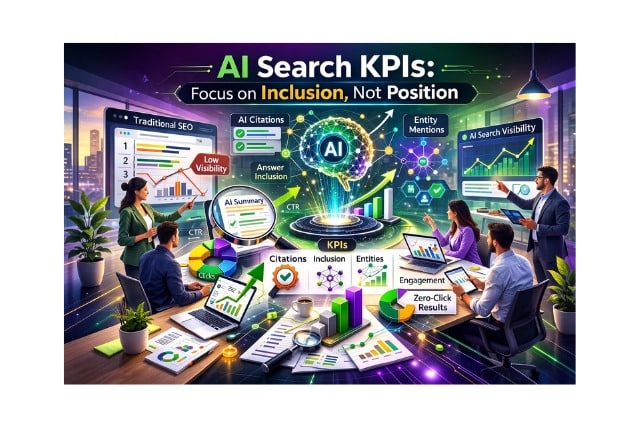
AI Search KPIs: focus on inclusion, not position, is transforming how SEO teams measure success effectively in AI-driven search. It pushes teams away from old rank-tracking habits consistently across campaigns. It ensures brands achieve real presence inside AI answers quickly and reliably.
More so, it highlights actual influence on user decisions across multiple queries at once. It guides content choices toward improved visibility and stronger authority in AI search.
It replaces position obsession in twenty-six SEO reports successfully. It drives smarter strategies across all content, technical, and analytics teams today.
Moreover, traditional rankings lose relevance when AI answers appear first for most users consistently. Teams track whether content receives inclusion in those AI-generated responses regularly.
Inclusion demonstrates genuine brand reach and strengthens authority inside AI summaries and results over time. Therefore, teams gain measurable authority when inclusion grows across different AI outputs. Leaders notice stronger results from inclusion-driven metrics compared to focusing solely on page position rankings.
Why Inclusion Matters More Than Rankings in AI Search
First, studies show that sixty percent of users make decisions without clicking on search results now. Inclusion occurs when content appears directly inside AI-generated answers instead of relying on organic traffic.
So, leaders report higher brand recall when content is included consistently across multiple queries and platforms. Teams with inclusion-focused KPIs achieve broader reach and maintain authority across AI-driven search systems reliably.
Understanding inclusion provides clear insight into visibility beyond traditional position-based metrics for SEO teams today.
Understanding AI Search KPIs_ AI Search KPIs: Focus on Inclusion, Not Position
However, AI search KPIs measure content presence inside answers rather than page order now. AI pulls data from multiple sources to generate complete, informative responses for users efficiently.
Teams learn how AI interprets structure, entities, and topics to determine which content to include. Monitoring AI KPIs allows teams to make informed content decisions and optimize strategies for maximum visibility consistently.
The Problem With Focusing Only on Position
Next, high page rankings do not guarantee inclusion in AI-generated summaries or answers. Zero-click searches grow as AI systems satisfy user intent without sending traffic to websites.
Teams focusing solely on rank waste effort while competitors gain inclusion without high positions. Understanding the limitations of traditional ranking metrics encourages the adoption of inclusion-focused strategies for modern SEO.
What Inclusion Means in AI Search
Consequently, inclusion occurs when AI cites content or integrates facts directly into its answers. Entity recognition allows AI to connect brands to relevant topics clearly across queries.
Teams build authority gradually as inclusion increases across multiple AI-generated answers and knowledge platforms. Inclusion-focused metrics provide reliable insight into a brand’s influence and reach beyond organic rankings.
Key Metrics to Measure AI Inclusion
Furthermore, teams track several measurable KPIs to monitor inclusion effectively each week:
- Citation Frequency in AI Search: Count how often AI quotes exact content within answers.
- Answer Inclusion Rate: Calculate the percentage of target queries where content appears in AI answers.
- Entity Mentions and AI Indexing: Track brand or key entity mentions for trust and relevance.
- Knowledge Graph Participation: Monitor involvement in knowledge graphs that feed AI systems consistently.
Tracking these KPIs reveals how content performs within AI-driven search environments efficiently.
Tools to Track AI Search Inclusion_ AI Search KPIs: Focus on Inclusion, Not Position
In addition, teams leverage free AI prompts in ChatGPT and Perplexity weekly to test inclusion. Teams combine traditional SEO dashboards with AI-specific analytics platforms to view performance holistically.
Teams also maintain simple spreadsheets or automated logging systems to track inclusion data reliably every week.
Optimizing Content for AI Inclusion
Moreover, semantic content improves AI comprehension by structuring headings, lists, and modular sections clearly. Teams apply schema markup to help AI parse content correctly and enhance machine readability. Teams develop short, focused sections that answer individual questions for stronger AI response inclusion.
Shifting Content Strategy From Rankings to Inclusion
Next, teams prioritize knowledge-rich pages, expert quotes, and unique data for AI responses. Teams focus on relevance, clarity, and entity accuracy instead of keyword stuffing or density alone. Teams implement zero-click AI search optimization to secure consistent inclusion in AI-generated answers.
Common Challenges and How to Overcome Them
However, AI answers fluctuate frequently, making inclusion tracking difficult without standardized processes. Teams solve this by testing queries consistently each week to monitor changes. Teams train all members to prioritize inclusion metrics rather than ranking positions exclusively.
Teams implement these practical steps:
- Conduct weekly AI prompt tests and log results accurately.
- Compare competitor inclusion rates during monthly strategy meetings.
- Adjust content to address gaps in entity mentions and citations immediately.
Advanced Techniques for Experts + Future-Proofing
Therefore, predictive models help teams forecast inclusion opportunities in advance and stay competitive. Teams map entities strategically to strengthen connections within knowledge graphs. Teams prepare for multi-agent AI environments where inclusion determines visibility and performance outcomes.
Measuring AI SEO Performance Through Inclusion
Teams monitor AI visibility metrics weekly to confirm real improvements in search presence. Inclusion tracking guides every content decision and ensures sustained authority across AI platforms.
Finally, AI Search KPIs: Focus on inclusion, not position, helps teams redefine SEO success today. Teams adopt AI visibility metrics to track reach across multiple platforms effectively.
Teams monitor citation frequency, answer inclusion rates, and entity mentions accurately. Teams improve knowledge graph participation and optimize semantic content consistently.
Teams define AI-specific KPIs for leadership and performance reporting. Teams integrate machine-readable dashboards to track long-term AI performance reliably. Teams master inclusion-focused SEO strategies for lasting advantage and measurable results.
Frequently Asked Questions
What does inclusion mean in AI search KPIs?
Inclusion measures how often AI systems cite or feature content in summaries and answers.
Why is position less important in AI-driven search?
AI agents display answers directly, making traditional ranking metrics insufficient for visibility.
How can teams track inclusion effectively?
Teams monitor citation frequency, answer inclusion rate, and entity mentions using AI analytics dashboards.
What strategies improve AI search inclusion?
Structured content, schema markup, clear headings, and entity-focused writing help AI understand content better.
Do inclusion KPIs replace traditional SEO metrics completely?
Teams maintain rankings for humans while prioritizing inclusion to optimize content for AI results efficiently.
Conclusion
Finally, AI search KPIs: focus on inclusion, not position, enabling SEO teams to succeed in AI-first search environments. Inclusion metrics reveal which content AI cites, summarizes, or references across platforms.
Teams focusing on inclusion maintain authority, visibility, and engagement even as traditional rankings fluctuate. Optimizing for AI-driven inclusion complements human-focused SEO strategies effectively.
Teams gain measurable results by tracking citations, answer presence, and entity mentions consistently. Shifting from ranking obsession to inclusion-oriented KPIs ensures sustainable, long-term success in AI-powered search.


 Presidents' Day Sale - 20% Off
  Groundhog Day Sale - 20% Off