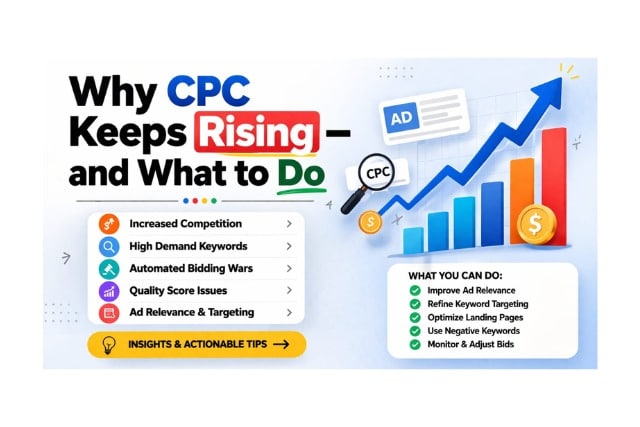
Are you wondering why CPC keeps rising—and what to do to get better results with your advertising budget? It was once common for marketers to see low costs and easy clicks.
Over time, they noticed costs slowly climbed while results stayed the same. That shift created confusion and pressure. So, this guide will help you understand what changed and how you can take control again.
In the past, running paid ads felt simple. You chose a few keywords, set a budget, and clicks came at a fair price. Today, things feel different. Costs rise faster, competition grows stronger, and results take more effort.
Moreover, the truth stands clear. CPC is not rising for one reason. Many changes have shaped the ad space. More businesses now compete online. Platforms use smart bidding systems. User data has become limited. All these shifts affect how much you pay for each click.
Nevertheless, rising CPC does not mean failure. It only means you need a better plan. Advertisers who understand the real causes can adjust their strategy and protect their budget. So, this guide explains those changes and shows what actions can help you stay profitable.
What Is CPC in Digital Advertising
CPC stands for cost per click, which means advertisers pay only when users click their ads. Platforms like Google Ads run auctions where bids and quality signals determine how much each click costs.
Additionally, Google evaluates several factors during auctions, including ad relevance, expected click rate, and landing page quality. Higher quality ads often win better positions and lower costs compared to poorly optimized campaigns.
Furthermore, CPC differs from other pricing models, such as CPM and CPA, in digital advertising systems.
- CPM charges advertisers for impressions, which means payment occurs for every thousand views, regardless of clicks.
- CPA charges only after a conversion, such as a sale or lead, which shifts risk to platforms.

No Tech Jargon. Just More Customers.
We aren’t here to hide behind abstract technical metrics to mask a lack of results. Most agencies use complex algorithmic jargon just to confuse you and justify overcharging. JoseOne enjoys literally 100% client retention because, nothing is expensive when it’s worth what you pay for it.
Current CPC Trends and Benchmarks in 2025–2026 (What the Data Shows)
Rising cost per click trends appear across most industries today. The average search CPC reached $5.26 in 2025. Legal services often hit $8.58 per click. Dental and home services sit near $7.85. Arts and entertainment stay low at $1.60.
High-CPC industries include legal, insurance, and SaaS. These fields offer a big lifetime value per customer. Lower-CPC niches cover travel, restaurants, and e-commerce at $1.50 to $2.50.
Mobile CPC usually runs higher than desktop. Users on phones show stronger intent, but smaller screens limit ad space. Search ads cost more than display ads. Display CPC averages just $0.63.
Why CPC Keeps Rising in 2026 — Core Reasons Explained
Why paid ads are getting expensive comes down to simple supply and demand. More businesses enter online auctions every month. Ad inventory stays limited as a result.
Furthermore, the increase in digital advertising costs also stems from AI overviews. These summaries answer questions on the page. Fewer users click through to sites. The remaining clicks become more valuable and costly.
In addition, smart bidding pushes prices higher, too. Google’s automation considers millions of signals in seconds. Many advertisers use it now. The whole auction climbs as a result.
Besides that, privacy changes cut third-party data. Advertisers target broader groups. Why paid ads are getting expensive grows from weaker signals and more waste. Inflation adds pressure as overall marketing budgets rise.
How the Google Ads Auction Really Drives Your CPC Higher
Ad Rank decides who shows and where. It combines your bid with a quality score and other factors. A better rank can lower your actual CPC.
Quality Score plays a huge role in every auction. Scores range from 1 to 10. High scores reward relevant ads and pages. Low scores force you to bid more to compete.
Bid strategies shape costs directly in practice. Manual bidding gives you full control. Smart bidding saves time but can raise averages in competitive auctions. Real examples show that a $2 bid with poor quality can cost $4.50. The same bid with strong quality drops to $1.80.
Hidden Factors That Silently Increase Your CPC (Most Advertisers Miss These)
Broad match keywords trigger irrelevant searches daily. Costs add up fast from wasted clicks.
Weak ad copy leads to low CTR in many cases. Google sees poor performance and charges more. Landing pages that load slowly or miss the promise hurt experience scores.
Irrelevant audience targeting wastes budget quickly. Ads show to people who never convert. These hidden issues compound the digital advertising cost increase quietly.
How to Diagnose Rising CPC in Your Own Account (Step-by-Step Guide)
Open Google Ads reports first every week. Check the average CPC over the last 30 days. Compare it to prior periods for patterns.
Track key metrics daily without fail. Watch CTR, quality score, and conversion rate. Spot keywords that eat most of your spend.
Use Auction Insights to view competitors directly. See who outranks you and why. So, this quick check reveals high-CPC keyword solution opportunities.
Proven Strategies to Control CPC: Why CPC Keeps Rising—And What To Do
Effective strategies help reduce costs while improving campaign performance and maintaining steady growth over time.
- Add negative keywords regularly to block irrelevant traffic and reduce wasted ad spend.
- Focus on high-intent keywords that align closely with user searches and business goals.
- Improve ad copy to increase engagement and raise click-through rates.
Additionally, optimize landing pages to ensure fast loading speed and clear messaging that matches user expectations.
Advanced Expert Tactics — Smart vs. Manual Bidding, Audience Layering, Dayparting, and First-Party Data
Google Ads bidding strategies matter at scale for growth. Manual bidding works for new or small accounts. You set exact limits. Smart bidding shines with 50+ conversions per month. It learns fast.
So, layer audiences on top of keywords for precision. Remarketing lists boost relevance. Dayparting adjusts bids by hour or day. Show ads only when your audience buys.
First-party data sharpens targeting effectively. Upload customer lists. Build lookalikes. These steps deliver CPC optimization strategies that beat automation alone.
Budget Management, SEO Integration & Avoiding Costly Mistakes
Allocate budget to top keywords first. Scale slowly after you prove ROI. Pause campaigns that lose money for two weeks straight.
Why paid ads are getting expensive makes SEO essential now. Organic traffic reduces reliance on paid clicks. Combine both for steady leads at a lower total cost.
Common mistakes hurt results in many accounts. Chasing only high-volume keywords drains funds. Poor tracking hides real performance. Ignore search intent, and you pay for tire-kickers.
Reduce ad spend waste by testing ads regularly. Fix conversion tracking early. Match every ad to the exact user needs.
Simple Affordable Rates
At JoseOne, we keep it simple. You don’t need a degree in search engine mechanics—you just need more traffic, more phone calls, and more sales. We offer one, fully-loaded package for just $3 per day, to get your business ranking higher on Google, with a 100% Money-Back Guarantee. We handle the technical heavy lifting so you can focus on running your business.
The Future of CPC Beyond 2026 — What to Expect and How to Prepare
AI will automate more auctions in the coming years. Cookieless worlds push first-party data harder. Brand authority will matter more. Strong sites earn better positions at lower costs.
Prepare now with clear steps. Build your own audience lists. Strengthen landing pages. Diversify beyond Google Ads. These moves keep profits safe.
Best Tools to Optimize CPC: Why CPC Keeps Rising—And What To Do
Several tools help advertisers monitor performance and improve campaign results through better insights and data analysis.
- The Google Ads dashboard provides real-time data and performance tracking for campaigns.
- Google Analytics tracks user behavior and conversion paths across websites.
- SEMrush and Ahrefs reveal keyword opportunities and competitor strategies.
Additionally, heatmap tools identify user behavior on landing pages, which helps improve conversion rates and user experience.
Final Action Plan: Stay Profitable Despite Rising CPC in 2026
Start today with a quality score audit. Add 20 negative keywords this week. Test one new bidding approach. Track results weekly. Why CPC keeps rising will continue, yet prepared advertisers win bigger margins.
More so, CPC optimization strategies and paid ads cost control tips give you the edge. Apply them consistently. Your campaigns stay profitable even as CPC keeps rising, which pressures the market. Take action now and turn higher costs into stronger returns.
Frequently Asked Questions
Why does CPC keep rising even when ads perform well?
More advertisers compete for the same audience. Even strong ads must enter a crowded auction. So, this competition increases costs over time.
What to do when CPC keeps rising in campaigns?
Focus on improving the quality score first. Refine targeting next. Remove wasted spend through negatives. Small changes reduce costs over time.
Is rising CPC a bad sign for business growth?
Rising CPC does not always signal trouble. It can mean strong demand in your market. Your return on investment matters most.
How can small businesses handle rising CPC?
Small businesses focus on local keywords. They use better targeting. Strong landing pages help them compete without overspending.
Can CPC be controlled or reduced over time?
Yes, proper optimization delivers results. Regular testing and strategy adjustments lower costs. Performance improves as a direct outcome.
AT Final Words
In conclusion, CPC continues to rise because competition increases and advertising platforms evolve with new technologies. However, rising costs do not prevent success when advertisers adapt strategies and focus on efficiency.
Finally, understanding causes and applying improvements helps maintain strong performance even in competitive environments. Why CPC Keeps Rising—And What To Do remains a challenge, yet smart planning turns that challenge into an opportunity.